Cnet News(2003)「25周年を迎えた、インテルのx86アーキテクチャ」Cnet Japan, 2003/06/10 15:46
http://japan.cnet.com/news/ent/20055162/
http://news.com.com/2100-1006_3-1014744.html
Krazit,Tom(緒方亮;高森郁哉,2007)「30周年を控えるx86アーキテクチャ–「愛され続ける」その理由」Cnet Japan, 2007/04/12 17:46
http://japan.cnet.com/news/commentary/20346995/
http://japan.cnet.com/news/commentary/20346995/2/
http://japan.cnet.com/news/commentary/20346995/3/
Shankland, Stephen(河部恭紀訳, 2006)「インテル、次期Itaniumではx86ハードウェアサポートを搭載せず」Cnet Japan, 2006/01/20 11:55
http://japan.cnet.com/news/ent/20094826/
http://news.com.com/2100-1006_3-6028817.html
Cnet「インテル、64bitプロセッサ戦略を早くも軌道修正」Cnet Japan, 2003/04/24 22:22
http://japan.cnet.com/news/ent/20053929/
コンピュータに関する歴史的=理論的研究
History and Theory of Computer by 佐野研究室
日本のPC市場シェア1990 vs 2010
1990年の日本PC市場シェア
| 順位 | 企業名 | シェア |
| 1 | NEC | 51.0% |
| 2 | 富士通 | 12.7% |
| 3 | 東芝 | 12.5% |
| 4 | セイコーエプソン | 10.0% |
| 5 | 日本IBM | 7.0% |
| 6 | その他 | 6.8% |
2010年の日本PC市場シェア
| 順位 | 企業名 | シェア |
| 1 | NEC | 19.3% |
| 2 | 富士通 | 19.0% |
| 3 | 東芝 | 11.2% |
| 4 | デル | 9.7% |
| 5 | HP | 9.6% |
| 6 | その他 | 31.2% |
日本のパソコンメーカーのPC世界出荷台数および市場シェア
| 企業名 | 主要ブランド名 | 世界出荷台数 | 市場シェア | |
| 東 芝 | ダイナブック | 1,910万台 | 5.2% | |
| ソニー | バイオ | 877万台 | 2.1% | |
| 富士通 | FMV | 567万台 | 1.8% | |
| NEC | LaVie | 306万台 | 0.9% | |
| パナソニック | レッツノート | 約70万台 |
日本のパソコンメーカーのPC市場撤退時期
| 企業名 | 主要ブランド名 | 撤退時期 |
| 三菱電機 | ペディオン | 1999年4月 |
| 日立製作所 | プリウス | 2007年10月 |
| シャープ | メビウス | 2010年10月 |
[引用元]日経産業新聞(2011)「HP、PC分離へ、国内上位勢、規模拡大急ぐ――富士通など海外強化」『日経産業新聞』2011年8月22日
[元データ]米IDC
プログラミング言語の歴史に関する文献
単行本
- Rosen, Saul, (ed.) (1967), Programming Systems and Languages, McGraw-Hill
- Sammet, Jean E.(1969), Programming Languages: History and Fundamentals, Prentice-Hall
- Richard L. Wexelblat (ed.) (1981) History of Programming Languages, Academic Press
- Thomas J. Bergin and Richard G. Gibson (eds.) (1996) History of Programming Languages, Addison Wesley
論文 — 発表年代順
- Sammet, Jean E.(1972), “Programming Languages: History and Future”, Communications of the ACM, 15(7), July 1972
- Wegner,P.(1976) “Programming Languages — The First 25 Years,” IEEE, Vol. C-25, No.12, pp.1207-1225
- Backus. J. (1978) “The History of FORTRAN I, II,and III,” SIGPLAN Notices, Vol. 13, No. 8,Proc. History of Programming Languages Conference, pp. 165-180
同論文はAnnals of the HIstory of Computing, Vol. 1, No 1 (July 1979)に再録されている. - Takeshita, T. (1972) “Survey of Programming Languages in Japan,” Proc. 1st USA-JAPAN Computer Conference
- 中田育男(1980)「プログラミング言語の歴史と展望」『情報処理』2l(5),pp.574~582(1980-5)
- 『情報処理』22(6)の大特集「プログラミング言語の最近の動向」
-
1. 中田育男(1981)「プログラミング言語の最近の動向について」」『情報処理』22(6),pp.445-447
2. 徳田雄洋(1981)「プログラミング言語に関する一般的参考文献」『情報処理』22(6),pp.448-451
3. 菅忠義(1981)「FORTRAN」『情報処理』22(6),pp.452-456
4. 今城哲二「COBOL」『情報処理』22(6),pp.457-460
5. 川合慧(1981)「ALGOL60/ALGOL68」『情報処理』22(6),pp.461-464
6.「PL/I」『情報処理』22(6),pp.465-468
7.「LISP」『情報処理』22(6),pp.469-472
8.「SNOBOL」『情報処理』22(6),pp.473-476
9.「SIMULA」『情報処理』22(6),pp.477-482
10.「BASIC」『情報処理』22(6),pp.483-487
11.「APL」『情報処理』22(6),pp.488-492
12.「PASCAL」『情報処理』22(6),pp.493-496
13.「ADA」『情報処理』22(6),pp.497-500
14.「マイクロコンピュータ用言語」『情報処理』22(6),pp.501-504
15.「マクロ言語」『情報処理』22(6),pp.505-509
16.「システム記述言語」『情報処理』22(6),pp.510-514
17.「仕様記述言語」『情報処理』22(6),pp.515-519
18.「テストプログラム記述言語」『情報処理』22(6),pp.520-524
19.「抽象データ型言語」『情報処理』22(6),pp.525-530
20.「並列処理言語」『情報処理』22(6),pp.531-534
21.「人工知能用言語」『情報処理』22(6),pp.535-539
22.「シミュレーション言語」『情報処理』22(6),pp.540-544
23.「事務処理用簡易言語」『情報処理』22(6),pp.545-549
24.「エンドユーザ用言語」『情報処理』22(6),pp.550-554
25.「データベース用言語」『情報処理』22(6),pp.555-558
26.「文書整形言語」『情報処理』22(6),pp.559-564
27.「数式処理言語」『情報処理』22(6),pp.565-569
28.「ハードウェア記述言語」『情報処理』22(6),pp.570-573
29.「数値制御用言語」『情報処理』22(6),pp.574-578
30.「プロセス制御用言語」『情報処理』22(6),pp.579-582
31.「関数型言語」『情報処理』22(6),pp.583-587
32.「述語論理型言語」『情報処理』22(6),pp.588-591
33.「言語設計プロジェクト」『情報処理』22(6),pp.592-595 - 高橋秀俊(1983)『情報科学の歩み』岩波書店の第5章「ソフトウェアという機械」中田育男(1987)
- 「FORTRANコンパイラの開発」『コンピュータソフトウェア』 4(1), pp.53-61, 1987-01-14
- 渡邊担、藤波順久、中田育男(1999)「コンパイラ研究の動向について」『コンピュータソフトウェア』16(2), pp.175-178, 1999-03-15
WEB記事
パラメトロン素子に対する批判的見解
臼井健治(1986)『日本のコンピュータ開発群像』にっかん書房における記述
日本電気の出川雄二郎氏の証言
「あのころは、パラメトロンの呼び声が高くて、どっちかといえば、パラメトロンをやる人
のほうが偉いようなことをいわれていた。そこをトランジスターでやったのが、和田さんの偉いところだ。」
日本電気の遠藤良明氏の証言
「パラメトロンは、スピードに限界があり、電力も食いすぎる。いずれトランジスターに移ることは予想されていたし、MARK-Wが事務用を指向していることも、今後のコンピューターにふさわしいと思った。これを基礎にすれば事務用の実用化が早まるだろう、これを導入すべきだと考えて、帰って上司に報告した」p.306
日本電気の小林宏治氏の証言
「パラメトロンは、電源がとんでもなく要る。商用には不向きだ。電気試験所はMARK-IVをトランジスターでやっているのだから、これとタイアップして商用のコンピューターをつくろう。IBMがノウハウをくれないなら、これと競争して負かしてやろうと、大それたことばかり考えていた。そのころ、IBM650の大量もちこみの噂があったが、同じくらいのものをトランジスターでやったら勝つだろう、というわけだった」p.307
「あのころは、パラメトロンの呼び声が高くて、どっちかといえば、パラメトロンをやる人
のほうが偉いようなことをいわれていた。そこをトランジスターでやったのが、和田さんの偉いところだ。」
日本電気の遠藤良明氏の証言
「パラメトロンは、スピードに限界があり、電力も食いすぎる。いずれトランジスターに移ることは予想されていたし、MARK-Wが事務用を指向していることも、今後のコンピューターにふさわしいと思った。これを基礎にすれば事務用の実用化が早まるだろう、これを導入すべきだと考えて、帰って上司に報告した」p.306
日本電気の小林宏治氏の証言
「パラメトロンは、電源がとんでもなく要る。商用には不向きだ。電気試験所はMARK-IVをトランジスターでやっているのだから、これとタイアップして商用のコンピューターをつくろう。IBMがノウハウをくれないなら、これと競争して負かしてやろうと、大それたことばかり考えていた。そのころ、IBM650の大量もちこみの噂があったが、同じくらいのものをトランジスターでやったら勝つだろう、というわけだった」p.307
日本におけるTSS
日本における最初期のTSS研究
「(1963年に開設された大阪大学の計算センターは、1965年にIBM・WTCからIBM7090の無償提供の申し出を受け、同機を入れるかどうで大議論になったが、最終的にはNEAC2200-500という当時の大型機を入れることに決め、1970年までは同機の無償提供を受けたが)安井氏によると、「大型センターができてからは、NEAC2200-500を中心とするTSS(タイム・シェアリング・システム)をやるので、その阪大スタッフの一員ということで、TSSを手がけることになった」TSS研究も、これが日本初だった。」臼井健治(1986)『日本のコンピュータ開発群像』にっかん書房,pp.56-57
コンピュータの定義をめぐる論争 - 「プログラム内蔵方式のデジタル型電子式計算機」という説をめぐって
「最初のコンピュータとは何か?」という問いにどのように答えるのかは、コンピュータをどのようなマシンと定義するのかという問題でもある。「コンピュータと呼ばれているもの」をどのように定義するのかに関しては様々な議論がある。
事典や辞書などにおけるコンピュータの定義に関しては、本サイトの下記ページで紹介している。
ここでは、コンピュータ=「プログラム内蔵方式のデジタル型電子式計算機」という定義を取りあげ、いくつかの議論を紹介しておくことにしよう。
コンピュータ=「プログラム内蔵方式のデジタル型電子式計算機」という定義の理解
プログラム内蔵(stored program)方式とは何であるかという概念的規定それ自体も歴史的に捉える必要がある。ただしここでは作業仮説として、とりあえず星野力(1995)『誰がどうやってコンピュータを創ったのか? 』p.35における下記規定のように「内部記憶中にプログラムが内蔵されている」こととする。
「プログラムは、それが実行されるときには、計算機械の内部にあるメモリ中に記憶され、計算と同じ速度で取り出されなくてはならない」
ただし星野力氏は、下記のように「プログラム内蔵」だけでは不十分で、「プログラム可変内蔵」と定義すべきだとしている。すなわち、「プログラム内蔵」に関して、「プログラム可変内蔵」と「プログラム固定内蔵」の2タイプを分けて考えるべきだとした上で、「プログラム可変内蔵」=「コンピュータ」と定義している。
「本書ではコンピュータを、実行時にプログラムを書き換え可能なもの(プログラム可変内蔵)と定義するので、ENIACはコンピュータとはいえない。」としている。ただし星野氏は「〈可変〉を取り除いて単に〈プログラム内蔵〉とすれば、一九四八年の改造されたENIACが最初であろう。」(p.81)
「後の一九四八年、一入力対一〇〇出力のマトリックススイッチを命令デコーダ(解読器)とするような改造が行われ、メトロポリスは(フォン・ノイマン夫人のクララの助けによって)この機能により、世界最初のモンテカルロ法を計算している。/このことからENIACは十分にプログラム固定内蔵方式といえる。」(p.90)、「ENIACの革新的意味は何だろうか?それは電子式で、デジタル方式で、プログラム内蔵型で、実用規模の科学計算汎用である計算機械として、世界最初のものである。」(pp.96-97)
「後の一九四八年、一入力対一〇〇出力のマトリックススイッチを命令デコーダ(解読器)とするような改造が行われ、メトロポリスは(フォン・ノイマン夫人のクララの助けによって)この機能により、世界最初のモンテカルロ法を計算している。/このことからENIACは十分にプログラム固定内蔵方式といえる。」(p.90)、「ENIACの革新的意味は何だろうか?それは電子式で、デジタル方式で、プログラム内蔵型で、実用規模の科学計算汎用である計算機械として、世界最初のものである。」(pp.96-97)
プログラム内蔵方式という考え方の発案者をめぐる議論
プログラム内蔵方式という考え方の発案者はノイマンとされることが多い。その一方で、「エッカートが1944年1月にはプログラム内蔵方式に気づいていた」という説といった異論がある。下記ではそうした異論に対する批判的議論を紹介する。
- 星野力(1995)『誰がどうやってコンピュータを創ったのか』共立出版の第6章3節「プログラム内蔵方式は誰の発明か?」(p.104-)における「エッカート」説批判
同書では、エッカートとモークリーによって1945年9月に書かれたEDVACのプログレスレポート、バークスによる証言(Burks et al.,1988) 、1970年代のスペーリ・ランド対ハネウェルのENIAC訴訟のときに弁護士によって発掘された文書「文書磁気ディスクに関する覚書」などに基づきながら、エッカート説に対するゴールドスタインの批判、および、エッカートとモークリによるゴールドスタインの議論に対する反論が紹介されている。
なおこの論争に関して星野氏自身は、下記のように、エッカートは「磁気ディスクや遅延線という内部記憶装置の考案」=「プログラム可変内蔵というアーキテクチャの考案」と考えているが、そうした同一視はあまり適切ではない、としている。ハードウェアを考案したこと「エッカートらは磁気ディスクや遅延線というハードウェアを考案したことは、直ちにプログラム可変内蔵というアーキテクチャも考案したことである、といったような認識をどこかにもっているように思える。これに対して後世では(当時でもフォン・ノイマンは)、プログラム可変内蔵方式の本質は論理的なレベルにおけるアーキテクチャと、そのチューリングマシンとしての万能性にある、と理解していることである。これが正しいとすれば、フォン・ノイマンの業績は、プログラム可変内蔵方式を論理的に明確にし発展させたということであろう。」(p.109)というように主張している。- 横山保(1995)『コンピュータの歴史』中央経済社における「エッカート」説批判=「(最初の)ENIACは、ワイヤリング方式によるプログラム入力であったため、プログラム内蔵式ではない」
横山保(1995)は「ENIACの大きな欠点の一つは、プログラムの作成がプラグ、ソケットによるワイヤリング(wiring)方式であることであった。一つのプログラムをつくるのに、数人の人によって数日を要し、数百のワイヤーの結合を行わなければならなかった。この欠点を解決し、完全なフレキシシビリティをもたせるようにしたのがプログラム内蔵式(stored program)の考えである。この考えは主に、ジョン・フォン・ノイマン(John von Neumann,1903-1957)によるものである。」(p.84)としている。
ただしその一方で、Burks, A.W.,Godstein, H.H., von Neumann, J. (1946) “Preliminary Discussion of the Logical Design of an Electronic Computing Instrument”などを典拠として「1944年、ゴールドスタインはノイマンにENIAC計画を説明している。そして両者はプログラム内蔵式の考えを発表している」(p.85)としている。[関連参考論文]- Burks, A.W.,Godstein, H.H., von Neumann, J. (1946) “Preliminary Discussion of the Logical Design of an Electronic Computing Instrument”
https://www.cs.princeton.edu/courses/archive/fall09/cos375/Burks.pdf - Metropolis and J. Worlton,(1972) “Trilogy of Errors in the History of Computing,” First USA-Japan Computer Conference Proceedings, pp.683-691
- Metropolis,et al.(Ed.1980)History of Computing in the Twentieth Century,Academic Press
本書中に、Burks, W.”From ENIAC to the Stored-Program Computer : Two Revolutions in Computers”(pp.311-344)や、Eckert,J.P.”The ENIAC”(pp.525-539)、Mauchly, J.W. “ENIAC” (pp.541-550)などが収録されている。
- Burks,Alice R., Burks,Arthur W.(1988) The Fisrt Electronic Computer, The Atanasoff Story, The University of Michigan Press[邦訳:大座畑、重光監訳『誰がコンピュータを発明したか』工業調査会,1998]
- 横山保(1995)『コンピュータの歴史』中央経済社における「エッカート」説批判=「(最初の)ENIACは、ワイヤリング方式によるプログラム入力であったため、プログラム内蔵式ではない」
プログラム内蔵方式を最初に実装したコンピュータをめぐる議論
プログラム内蔵方式の意義は多くの人々が理解していたが、コストなどの問題から実装は遅れた。プログラム内蔵方式を最初に実装したコンピュータがどれであるかについても下記のように「SSME」説、「EDSAC」説、「Manchester Mark I」説という少なくとも3つの説がある。
イギリスの「SSME」(Small-Scale Experimental Machine)説
イギリスの「EDSAC」説
イギリスの「Manchester Mark I」説
1.Napper, R.B.E.(2000) “The Manchester Mark 1 Computers1” in Rojas,R., Hashage, U. eds. (2000) The First Computers History and Architectures, pp.365-377
同論文のアブストラクトでNapperは、”This paper provides a brief history of the four related computers that were designed and built in Manchester from 1948 to 1951, and a summary specification of their architecture. Each machine has a strong claim to be a “first” in the history of stored-program computers, specifically allelectronic computers with an electronic store.”としながらも、SSEMが内蔵プログラム方式で駆動した最初のマシンであるとしている。(“The SSEM (June 1948) was the first such machine to work, thus realizing and proving the von Neumann ideal.”,p.365)
Burton, Christopher P. “Rebuilding the First Manchester Computer” in Rojas,R., Hashage, U. eds. (2000) The First Computers History and Architectures, pp.379-386
Burton, Christopher P. “Rebuilding the First Manchester Computer” in Rojas,R., Hashage, U. eds. (2000) The First Computers History and Architectures, pp.379-386
同論文のアブストラクトでBurtonは次のように1948年6月21日に内蔵プログラムを初めて動かした書いている。
“The University of Manchester Small-Scale Experimental Machine, the “Baby,” first ran a stored program on June 21, 1948, thus claiming to be the first operational general-purpose computer. ”
2.大駒誠一(2005)『コンピュータ開発史』共立出版,p.123およびp.126
「SSEMは、・・・1948年6月21日に最初のプログラムが動いた。世界で最初のプログラム記憶方式コンピュータである。」(p.123)
「このSSEMの性能はまったくたいしたものではなかったが、ちゃんとメモリ上に置いたプログラムが作動し、いわゆるフォン・ノイマン型の紛れもなくプログラム記憶方式のコンピュータである。EDSACを最初のプログラム記憶方式のコンピュータとする文献は多いが、これは間違いである。EDSACは最初に実用になったコンピュータではあるが、Babyのほうが約1年早くプログラム記憶方式のコンピュータとして動いた。」(p.126)
「このSSEMの性能はまったくたいしたものではなかったが、ちゃんとメモリ上に置いたプログラムが作動し、いわゆるフォン・ノイマン型の紛れもなくプログラム記憶方式のコンピュータである。EDSACを最初のプログラム記憶方式のコンピュータとする文献は多いが、これは間違いである。EDSACは最初に実用になったコンピュータではあるが、Babyのほうが約1年早くプログラム記憶方式のコンピュータとして動いた。」(p.126)
SSMEすなわちSmall-Scale Experimental Machineは、その名称を直訳すると「小規模実験機」となる。そのことからもわかるように、実験機であり、実用機とはいいがたい。そのため大駒氏自身も上記のように述べる一方で、SSEMの記憶容量はわずか32語(1語は32ビット)に過ぎず、実行可能な命令もったの7種類であったことから、「コンピュータというよりはむしろ、ウィリアムズ・キルバーン管(一種のブラウン管)がメモリとして使えるかどうかの、動作テスト機械であった」(p.123)としている。
なお大駒誠一氏は、Okoma, Seiichi(2000) “The First Japanese Computers and Their Software Simulators” in Rojas,R., Hashage, U. eds. (2000) The First Computers History and Architectures, p.421で富士フィルムのFUJICが1956年3月に日本で製造された最初のプログラム内蔵方式コンピュータであるとしている。
“The FUJIC, a monumental computer, was completed in March 1956. It was the first stored-program computer
made in Japan.”
3.日本語版ウィキペディア「計算機の歴史」
日本語版ウィキペディアでは、「(ENIACは)メモリに格納できる問題なら、どんな問題も計算できた。しかし、プログラムは配線やスイッチの状態によって定義されており、プログラム内蔵式とは言えない。」「プログラム内蔵式として設計された最初のコンピュータはEDVACだが、実際に最初に稼働したのはEDVACではない。エッカートとモークリーがプロジェクトを離れ、製作が停滞したためである。最初のノイマン型(プログラム内蔵式)コンピュータは1948年のマンチェスター大学の通称 “Baby”、正式名 Small-Scale Experimental Machine である。」としている。すなわち、Small-Scale Experimental Machineは「ウィリアムス管メモリを使ったプログラム内蔵式」で1948年6月に稼働していたのに対して、修正版ENIACが「配線変更とスイッチ設定によるプログラム制御とあわせ、Function Tables と呼ばれる機構をプログラム格納用ROMとして使ったプログラム内蔵式も可能」となったのは1948年9月、EDSACが「水銀遅延線メモリによるプログラム内蔵式」で稼働したのは1949年5月である、としている。http://ja.wikipedia.org/wiki/計算機の歴史(2013年6月23日アクセス)
- 星野力(1995)『誰がどうやってコンピュータを創ったのか』共立出版,p.81
「本書においては、(そして多くのコンピュータ科学・技術に携わる人たちの間では)コンピュータという用語は厳密には<プログラム可変内蔵方式>を意味している。第七章で述べるように、この意味で最初に実用に達したコンピュータは一九四九年のEDSACである。」(p.81)、<プログラム可変内蔵方式>という構想はすでにEDVACマシンの開発時から存在したが、「EDVACは開発関係者間の意見の対立により大幅に完成が遅れ」たため「世界最初のコンピュータ(プログラム可変内蔵方式と定義する)として出現したのは、このEDVACの影響下に、イギリスはケンブリッジ大学でモーリス・ウィルクス(Maulice Wilkes)によって製作され、一九四九年五月にプログラムの実行を開始したEDSAC(Electronic Delay Storage Automatic Calculator)(32ビット512語の遅延線メモリ、3,000本の真空管)だったのである。」(pp.118-119)としている。
- 横山保(1995)『コンピュータの歴史』中央経済社,p.85
「最初のプログラム内蔵式のコンピュータであるEDSAC・・・このコンピュータでは、ソフトウェアの出発点であるサブルーチン・ライブラリの仕事が行われている。このサブルーチン・ライブラリは150のサブ・ルーチンからなっていたといわれている。」
- Rojas,R., Hashage, U. eds. (2000) The First Computers History and Architectures, p.xii
Napper, R.B.E. “The Manchester Mark 1 Computers1″と、Burton, Christopher P. “Rebuilding the First Manchester Computer”の論文を紹介した説明文の中で、下記のように、Manchester Mark Iが世界最初のプログラム内蔵方式コンピュータである、としている。“Brian Napper and Chris Burton analyze the architecture and reconstruction of the Manchester Mark I, the world’s first stored-program computer.”
[改訂履歴]
2026年8月5日 文章表現の一部訂正
IBM PC vs Apple II
1982年半ばにおける販売予測
Wise, Deborah (1982) “The colossus runs, not plods – how the IBM PC came to be” InfoWorld, August 23, 1982によると、「今までのところ、[IBM PCに対する]市場の反応は熱狂的である。IBMは売り上げデータを発表していないけれども、アナリストはIBM PCの累計販売台数が現在50,000台にもなっており、本年末までには全部で20万台が出荷されるであろうと予測している。一方、IDCの推定によれば、Apple IIは1981年に13万5千台が売れると考えられている。」とされている。
ビル・ゲイツにおけるソフトウェアの互換性重視戦略
- CP/M-80との互換性を、CP-M/86よりも重視したMS-DOS
- ゲイツにおける「各社ミニコン用ソフトウェア間の互換性欠如問題」に関する認識
- MS-DOS vs CP-M/86
マイクロソフトのビル・ゲイツ(Bill Gates)は、『MS-DOSエンサイクロベディア Volume 1:システム解説編』(アスキー)[Woodcock(1989,pp.7-8)]の刊行に寄せた文章の中で、ソフトウェアの互換性に関して次のように述べている。
「MS-DOSの作成に当たって最も重要な3つの要因は、互換性の進化、Microsoft BASICの開発とパーソナルコンビュータ業界からの広範な支持、そして、IBMによる16ビットのテクノロジーを取り込んだコンビュータの製造の決定であった。(IBM PCに対する)支持と人気にとって、MS-DOSは必要欠くべからざるものだった。」
「1975年から1981年(8ビットマイクロコンピュータの時代)にかけて, Microsoft社は,事実上すべてのコンピニータメーカー(Raclio Shack、Commodore、Appleをはじめとする何十もの会社社)のそれぞれのマシンに、Microsoft BASICの搭載を決心させるに至った。初めて、すべてのハードウェアメーカーが足並みをそろえて共通の言語を持ったのである。我々のBASICの成功は、互換性の利点を世に示した。」
「我々はさらにMS-DOSの拡張を続け、MS-DOSが業界標準の地位に保たれるための本質たる互換性を犠牲にすることなく、もっと強力なコンピュータもサポートしてきた」
「1975年から1981年(8ビットマイクロコンピュータの時代)にかけて, Microsoft社は,事実上すべてのコンピニータメーカー(Raclio Shack、Commodore、Appleをはじめとする何十もの会社社)のそれぞれのマシンに、Microsoft BASICの搭載を決心させるに至った。初めて、すべてのハードウェアメーカーが足並みをそろえて共通の言語を持ったのである。我々のBASICの成功は、互換性の利点を世に示した。」
「我々はさらにMS-DOSの拡張を続け、MS-DOSが業界標準の地位に保たれるための本質たる互換性を犠牲にすることなく、もっと強力なコンピュータもサポートしてきた」
このようにゲイツは、PC用ソフトウェア市場におけるソフトの互換性の重要性を認識するとともに、マイクロソフトの相対的競争優位の確保のために互換性確保を意識的に追求してきた。
そのためMS-DOSの開発に際しては、8ビットPC用OS市場で事実上の標準になっていたCP/M-80との互換性確保を重要目標とすることで競争優位の確保を目指したのである。
「MicrosoftがMS-OOSの最初のバージョンを開発する際の目標の1つは, CP/M-80からMS-OOSへのソフトウェアの移植互換性である。」Woodcock(1989,p.32)
「8086は8080と互換性はなかったが、そのアーキテクチャは8080とよく似ており、8080のソースコードは機械的に変換すれば8086の上で動作するようになっていた。Tim Patersonの8086用のオペレーティングシステム、およびこのシステムの影響を受けたMS-OOSの最初のパージョンの設計方針は、8080用のコードが8086用のコードに変換できることに大きく影響を受けている。」Woodcock(1989,p.13)
「広範囲なアプリケーションや言語をユーザーが確実に使えるようにするには、8086用の標準的なオペレーティングシステムが絶対必要であると、Paterson(QDOSの仕事をしていた)もRod Brockも考えていた。CP/Mはすでに8ビットマシンの標準となっていたため、既存のCP/Mアプリケーションを機械的に変換して16ビットシステムで実行できるようにすることは、新しいオペレーティングシステムに向けての大きな目標の1つとなった。このような互換性を達成するために、彼が開発したシステムはFCBを採用し、実行可能ファイルへのアプローチの方法などの点でも、CP/M-80のファンクションとコマンドの仕様を模倣していた。」Woodcock(1989,pp.15-16)
「当然のことながら、MS-DOSはまずCP/M-80、次いでCP/M-86と比べられた。最大の関心事は互換性だった。Microsoftの新しいオペレーティングシステムは、いったいどの程度まで既存の標準と互換性があるのだろうか。」Woodcock(1989,p.30)
「最初にリリースしたMS-DOSver.l.Oは、Microsoftが思い描いていた16ビットコンビュータシステムのオペレーティングシステムの最終的な形とは違っていた。Bill Gatesによれば、「基本的に私たちがやりたかったことは、階層的ファイルシステムなど、どちらかといえばMS-DOSver.2に近いものだった。(ver.l.Oを開発する上で)鍵になったことは、『まず、サブセットでいこう。それから前進するのだ』という私の言葉だった」。/最初の版(GatesいうところのMS-DOSのサブセット)は、実際のところ、現在と未来の聞の良き妥協であった。それは、2つの点から語ることができる。まず、MicrosoftがIBMの開発計画に合わせることができたということ、そしてCP/Mとの間でプログラム変換による互換性を維持していたということである。」Woodcock(1989,p.23)
「既存の言語やWordStar、dBASEIIなどの人気のあるアプリケーションを使えるようにするために、MS-DOSは、ソフトウェア開発者が8080のソースコードを8086で実行できるかたちに機械的に変換できるように設計されていた。このために、MS-DOSはCP/M-80のように見えたし、そのように動作した。そのころCP/M-80は、まだマイクロコンビュータのオペレーティングシステムの標準だった。この8ビットの親戚と同様、MS-DOSは8文字のファイル名と3文字の拡張子を使用するほか、コマンドプロンプトの中でディスクドライブを識別する習慣を踏襲した。ほとんどの場合、MS-OOSはCP/Mと同じコマンド言語を使い、同様なファイルサービスを提供し、一般的な構造もCP/Mと同じになっていた。さらに、プログラミングレベルでの類似性には目を見張るものがあり、アプリケーションで使うことのできるシステムコールでは、CP/MとMS-DOSはほとんど1対1の対応を付けることができた。」Woodcock(1989,pp.23-24)
「8086は8080と互換性はなかったが、そのアーキテクチャは8080とよく似ており、8080のソースコードは機械的に変換すれば8086の上で動作するようになっていた。Tim Patersonの8086用のオペレーティングシステム、およびこのシステムの影響を受けたMS-OOSの最初のパージョンの設計方針は、8080用のコードが8086用のコードに変換できることに大きく影響を受けている。」Woodcock(1989,p.13)
「広範囲なアプリケーションや言語をユーザーが確実に使えるようにするには、8086用の標準的なオペレーティングシステムが絶対必要であると、Paterson(QDOSの仕事をしていた)もRod Brockも考えていた。CP/Mはすでに8ビットマシンの標準となっていたため、既存のCP/Mアプリケーションを機械的に変換して16ビットシステムで実行できるようにすることは、新しいオペレーティングシステムに向けての大きな目標の1つとなった。このような互換性を達成するために、彼が開発したシステムはFCBを採用し、実行可能ファイルへのアプローチの方法などの点でも、CP/M-80のファンクションとコマンドの仕様を模倣していた。」Woodcock(1989,pp.15-16)
「当然のことながら、MS-DOSはまずCP/M-80、次いでCP/M-86と比べられた。最大の関心事は互換性だった。Microsoftの新しいオペレーティングシステムは、いったいどの程度まで既存の標準と互換性があるのだろうか。」Woodcock(1989,p.30)
「最初にリリースしたMS-DOSver.l.Oは、Microsoftが思い描いていた16ビットコンビュータシステムのオペレーティングシステムの最終的な形とは違っていた。Bill Gatesによれば、「基本的に私たちがやりたかったことは、階層的ファイルシステムなど、どちらかといえばMS-DOSver.2に近いものだった。(ver.l.Oを開発する上で)鍵になったことは、『まず、サブセットでいこう。それから前進するのだ』という私の言葉だった」。/最初の版(GatesいうところのMS-DOSのサブセット)は、実際のところ、現在と未来の聞の良き妥協であった。それは、2つの点から語ることができる。まず、MicrosoftがIBMの開発計画に合わせることができたということ、そしてCP/Mとの間でプログラム変換による互換性を維持していたということである。」Woodcock(1989,p.23)
「既存の言語やWordStar、dBASEIIなどの人気のあるアプリケーションを使えるようにするために、MS-DOSは、ソフトウェア開発者が8080のソースコードを8086で実行できるかたちに機械的に変換できるように設計されていた。このために、MS-DOSはCP/M-80のように見えたし、そのように動作した。そのころCP/M-80は、まだマイクロコンビュータのオペレーティングシステムの標準だった。この8ビットの親戚と同様、MS-DOSは8文字のファイル名と3文字の拡張子を使用するほか、コマンドプロンプトの中でディスクドライブを識別する習慣を踏襲した。ほとんどの場合、MS-OOSはCP/Mと同じコマンド言語を使い、同様なファイルサービスを提供し、一般的な構造もCP/Mと同じになっていた。さらに、プログラミングレベルでの類似性には目を見張るものがあり、アプリケーションで使うことのできるシステムコールでは、CP/MとMS-DOSはほとんど1対1の対応を付けることができた。」Woodcock(1989,pp.23-24)
MS-DOSとCP-M/86のOS競争において最終的にMS-DOSが勝利した技術的要因の一つに、ディスクを管理するFATのデザインやシステム・コールの仕様などで、MS-DOSのほうがCP/M-80との互換性が高かったことに関しては、下川和男氏も次のように述べている。
「デジタルリサーチが、16ビット用ということで、CP/M-86に豊富な機能を盛り込んだのに対し、MS-DOSは、インテルの8086の設計思想と同様に、8ビットとの互換性を重視したのである。結果として素直に16ビットへの移行が行えるMS-DOSのアプリケーションが増加し、CP/M-86は消えていった。」下川和男(1994)
「互換性の進化は、Intel8080マイクロプロセッサの登場に始まる.この技術的な革新が、姿を見せ始めていたマイクロコンビュータ業界に空前の好機をもたらし、デスクトップにおけるコンビュータ利用のパワー、スピード、コストが持続的に改善されることが約束された。ミニコン市場における各ハードウェア製造業社は、それぞれ独自の命令セットとオペレーティングシステムを持っていた。したがって、特定のマシン用に開発されたソフトウェアは、他社のマシンとは互換性がなかった。この特殊化はまた、驚くべき努力の重複をも意味していた。メーカー各社はそれぞれの機種ごとに、言語コンパイラ、データベース、その他の開発用ツールを書かなくてはならなかったのである。8080マイクロプロセツサベースのマイクロコンビュータの登場によって、異なったメーカーが同ーの命令セットを持った同ーのチップを購入すると思われたので、状況は一変するものと期待された。」Woodcock(1989, p.7)
IBM PCが発売された当時は、マイクロソフトのMS-DOSがIBM PC用の標準的OSとなるとは考えられてはいなかった。実際、「InfoWorld誌の1981年のベストセラーリストの10本のプログラムのうち9本までがCP/M-80、またはCP/M-86で動作するものだった。CP/M-86が使えるようになったのは6か月後だが、商業誌などでほとんどのライターや評論家が選ぶオペレーティングシステムになっていた。」Woodcock(1989,p.30)のである。「MS-DOSがCP/Mに追い付くばかりか、追い越してしまうだろうということを予見した者は1人もいなかった。Bill Gatesでさえこう回顧している。「MS-DOSを使っているマシンの数は、最も楽観的な予測の数字でさえ、実際よりも少なかった」。まず第一に、IBM PCというマシンの成功が多くの産業評論家を驚かせた。発売後1年の聞に、IBMは月当たり30、000台のPCを売った。その大部分は、すでにIBMの名前と評価に親しみを感じているビジネスコミュニティ向けであったが、後から振り返ってみる限りでは、時代がパーソナルコンビュータに向かっていたことも事実である。もちろんMS-DOSは、このIBM PCの成功によって大きな利益を得ている。それは、IBMがすべての言語とアプリケーションをMS-DOSのフォーマットで提供したためである。
しかし、商業誌のライターは最初はまだCP/Mの優位を信じ、CP/M-80によって支配されている世界の中で、新しいオペレーテイングシステムが生き残る可能性について疑問を持っていた。彼らの多くは、CP/M-86マシンがCP/M-80アプリケーションを実行することができるという間違った認識を持っていた。CP/M-86が使えるようになる前から、Future Computing誌はIBM PCを、CP/Mレコードプレーヤと呼んでいた。これは、新しいコンビュータがCP/Mアプリケーションの膨大な資産を受け継ぐことを期待して、PCは実際にはCP/Mマシンであると考える方向に読者を誘導しようとしたものだった。
しかし、Microsoftが確信していたのは、まったく別のことだった。IBMのマシンおよびその他の16ビットマイクロコンビュータの成功の鍵は、業界の標準となる16ビットオベレーティングシステムが出現するかどうかだということだった。」Woodcock(1989,pp.30-31)
しかし、商業誌のライターは最初はまだCP/Mの優位を信じ、CP/M-80によって支配されている世界の中で、新しいオペレーテイングシステムが生き残る可能性について疑問を持っていた。彼らの多くは、CP/M-86マシンがCP/M-80アプリケーションを実行することができるという間違った認識を持っていた。CP/M-86が使えるようになる前から、Future Computing誌はIBM PCを、CP/Mレコードプレーヤと呼んでいた。これは、新しいコンビュータがCP/Mアプリケーションの膨大な資産を受け継ぐことを期待して、PCは実際にはCP/Mマシンであると考える方向に読者を誘導しようとしたものだった。
しかし、Microsoftが確信していたのは、まったく別のことだった。IBMのマシンおよびその他の16ビットマイクロコンビュータの成功の鍵は、業界の標準となる16ビットオベレーティングシステムが出現するかどうかだということだった。」Woodcock(1989,pp.30-31)
[参考文献]
Woodcock, Joanne(日笠健、長尾高弘監訳、1989)「MS-DOSの開発」『MS-DOSエンサイクロベディア Volume 1 システム解説編』アスキー
下川和男(1994)「ビル・ゲーツに囲まれて(前編) —- Windows HeartBeat #10」『月刊Windows World』(発行:IDG社)1994年5月号、http://www.est.co.jp/ks/billg/10_GATES.htm
Woodcock, Joanne(日笠健、長尾高弘監訳、1989)「MS-DOSの開発」『MS-DOSエンサイクロベディア Volume 1 システム解説編』アスキー
下川和男(1994)「ビル・ゲーツに囲まれて(前編) —- Windows HeartBeat #10」『月刊Windows World』(発行:IDG社)1994年5月号、http://www.est.co.jp/ks/billg/10_GATES.htm
NECとIntelの8086のマイクロプロセッサーの著作権をめぐる訴訟
Contreras,Jorge, Laura Handley and Terrence Yang (1990) “NEC v. INTEL : Breaking New Ground in the Law of Copyright,” Harvard Journal of Law & Technology, Volume 3, Spring Issue, 1990
http://jolt.law.harvard.edu/articles/pdf/v03/03HarvJLTech209.pdf
マイクロプロセッサーのマイクロコードの著作権をめぐるNECとIntelの裁判における1989年の判決[NEC Corp. & NEC Electronics, Inc. v. Intel Corp., No. C-84-20799, 1989 WL 67434]に関する論文。
同論文によると、 それ以前の判決 NEC Corp. v. Intel Corp., 645 F. Supp. 590 (N.D. Cal. 1986)は、判決を下した地裁判事がインテルの株式を所有していたことが判明したため無効となった。[NEC Corp. v. U.S. Dist. for N. Dist. Cal., 835 F.2d 1546 (9th Cir. 1988)]
同論文によると、判決の主要内容は下記の3点である。
- インテルのマイクロプロセッサーのROMの中に埋め込まれているマイクロコードは著作権保護の対象となること
- マイクロコードに関するリバースエンジニアリングはマイクロコードの著作権を侵害するものではないこと
- 類似のマイクロコードを「クリーンルーム」で独立に開発した場合には著作権侵害を犯していないことの説得的証拠となること
PCの歴史関連資料
1000Bit
http://www.1000bit.it/
1970年代後半期および1980年代おけるPC関連のデータベース、および、下記URLからパンフレット、広告、マニュアルなどの資料を見ることができる。
-
データベース
http://www.1000bit.it/database.asp?by=S_NOM
パンフレット
http://www.1000bit.it/ad/bro/brochures.asp
広告
http://www.1000bit.it/adverts.asp
マニュアル
http://www.1000bit.it/support/manuali/manuali.asp
山田昭彦(2014)「パーソナルコンピュータ技術の系統化調査」『国立科学博物館技術の系統化調査報告』(産業技術史資料情報センター)Vol.21、pp.218-319https://sts.kahaku.go.jp/diversity/document/system/pdf/086.pdf
インテルの社史
インテルの社史をインテル社の下記Webサイトからダウンロードすることができる。
http://www.intel.com/about/companyinfo/museum/archives/anniversary.htm
インテルの15年史
A Revolution in Progress (1968-1983)
印刷用PDF
インテルの20年史
Intel: Architect of the Microcomputer Revolution (1968-1988)
印刷用PDF
インテルの20年史
Defining Intel: 25 Years/25 Events (1968-1993)
印刷用PDF
インテルの35年史
Intel: 35 Years of Innovation (1968?2003)
印刷用PDF
1970年代前半期のmicrocomputerの広告等における性能・機能の「誇張」表現問題
1970年代前半期にはmicrocomputerに関する広告やマニュアルでは、下記のようにmicrocomputer製品の機能・性能がminicomputerと匹敵するかのように論じられているが、これはmicrocomputerやPersonal computerが製品カテゴリーとして認知されてはいないために最も近い既存製品カテゴリーに位置づけたことや、製品拡販のために一定の「誇張」表現を必要としたことによるものである。
1)R2E(Réalisation d’Études Électroniques)のMIcral(1973)
Micralは「極めて低コストであることを主要な特徴とする、初めての新世代ミニコンピュータである」(Réalisation d’Études Électroniques(1974) Micral Users Manual, p.76)とか、「普通のミニコンピュータが目的としない」プロセス制御がMicralの主要用途である(ibid.,p.66)とされている。
Réalisation d’Études Électroniques(1974) Micral Users Manual
http://bitsavers.org/pdf/r2e/MICRAL_N_Users_Manual_Jan74.pdf
2) MITSのAltair8800(1975)
MITSのAltair8800に関して、Popular Electronicsの1975年1月号表紙におけるキャッチコピーは 「商用モデルと競う、世界最初のミニコンピューターキット」(World’s first minicomputer kit to rival commercial models – the Altair 8800)、「これまでになされた中で最も強力なミニコンピューター・プロジェクト」(The most powerful minicomputer project ever presented – can be built for under $400)というものであり、Altair8800をminicomputerとするような記述がなされている。
またRoberts, H. Edward and William Yates (1975) “Exclusive! Altair 8800: the Most Powerful Minicomputer Project Ever Presented-Can be Built for Under $400,” Popular Electronics, January 1975, p.34においては、「[Altair]8800で使用されているCPUのインテル8080というLSIチップは、・・・現在の商用ミニコンピューターとその性能を競うミニコンピュータを創る役に立っている」(The CPU used in the 8800 computer, the Intel 8080 LSI chip, is relatively expensive in quantities of one. It was selected, however, because it serves to create a minicomputer whose performance competes with current commercial minicomputers)と言うように主張されている。
なお同論文のp.33ではAltair8800で使用されているインテルのCPU8080の「基本命令語は78語であり、通常のミニコンピューターの40語よりも多い」( It has 78 basic machine instructions ( as compared with 40 in the usual minicomputer)).とも書かれてている。
Tandy Radio Shack社のTRS-80関連資料
Tandy Radio Shack社のTRS-80の1977-1992年のカタログを見ることができるWeb
Ira Goldklang’s TRS-80 Revived Site
http://www.trs-80.com/wordpress/catalogs-radio-shack/
http://www.radioshackcatalogs.com/html/index_computer.html
カタログ本体のダウンロードできないが、カタログの一覧は下記にもある。
http://www.retrocomputing.net/parts/r/radio/TRS80_4/docs/trs80-cr.htm
TRS-80 Microcomputer News
http://www.trs-80.org/trs-80-microcomputer-news/
http://www.trs-80.com/wordpress/magazine-microcomputer-newsletter/
8008に関する証言
8008がDatapoint社の端末製品Datapoint2200に採用されなかった理由
Faggin, Federico(1984) “Interview : Federico Faggin”における証言 – 動作速度が遅かった
Fagginは、Datapoint社のインテリジェント端末をエミューレートするチップとして提供することを目的に開発された8ビットCPUの8008に関して、その動作速度が遅かった(it was slow)ため採用されなかったと証言している。
[出典]Faggin, Federico(1984) “Interview : Federico Faggin,” Computerworld, July 30 1984,p.6
[出典]Faggin, Federico(1984) “Interview : Federico Faggin,” Computerworld, July 30 1984,p.6
Zaks, R. (禿節史訳,1980)『マイクロプロセッサ』における記述 — 「動作速度が遅かったこと」、および、「バイポーラ素子の低価格の急速な進行」
これに関連してZaksは、同様に8008の動作速度が遅かったが、予想外なことにそれが売れた、という証言をおこなっている。またZaksは、データポイント社はバイポーラ素子の価格低下にともない、インテルが開発した8008ではなく、バイポーラ素子で端末を製造することにしたと述べている。
「その次の重要な出来事は、1972年に、同じくインテル社から最初の汎用8ビットマイクロプロセッサ8008が開発されたことである。その数年前に、デイスプレイ・ターミナル杜(現在のデータポイント社)がワンチップでCRTを制御するモノリシックのプロセッサ開発を要求し、競争の末、ふたつの半導体メーカが開発許可を得た。テキサス インスツルメンツ社とインテル杜である。数ヶ月間の努力の後、テキサス インスツルメンツ社が撤退した。一方、インテル社は開発を続け、ついにデータポイント杜の要求にあう素子を作り上げた。しかし、ただ一点だけ要求を満足させえなかった。動作速度が遅すぎたのである。その上、同じ時期に、パイポーラ素子の価格競争が始まり、どんどん価格が下がってきた。
インテル社が開発したプロセッサの動作速度が適当でなかったことと、バイポーラ素子の価格が非常に安くなったことなどから、データポイント社はバイポーラでその制御装置を作ることに決定した。インテル社には、その開発の結果できた素子が残ったが、その明確な市場はなかった。非常に新しい会社であった当時のインテル社の主力製品はメモリである。そこで、少しでも多くのメモリが売れればよいという仮定のもとに、(しぶしぶ?)この8008を市場に出したが、この設計に関するあらゆる仕事を中止し、開発グループも他の仕事に移り、マイクロプロセッサもこれで終りになるはずであった。
これを作った会社も、その競争相手も、ともに驚いたことには、この新製品(マイクロプロセッサ)が急に売れ始めたのである。」
[出典]Zaks, R. (禿節史訳,1980)『マイクロプロセッサ』マイテック、p.42
インテル社が開発したプロセッサの動作速度が適当でなかったことと、バイポーラ素子の価格が非常に安くなったことなどから、データポイント社はバイポーラでその制御装置を作ることに決定した。インテル社には、その開発の結果できた素子が残ったが、その明確な市場はなかった。非常に新しい会社であった当時のインテル社の主力製品はメモリである。そこで、少しでも多くのメモリが売れればよいという仮定のもとに、(しぶしぶ?)この8008を市場に出したが、この設計に関するあらゆる仕事を中止し、開発グループも他の仕事に移り、マイクロプロセッサもこれで終りになるはずであった。
これを作った会社も、その競争相手も、ともに驚いたことには、この新製品(マイクロプロセッサ)が急に売れ始めたのである。」
[出典]Zaks, R. (禿節史訳,1980)『マイクロプロセッサ』マイテック、p.42
8008とDatapoint社の端末製品Datapointとの関係
8008の起源に関するStan Mazorの証言(p.2) - 1969年12月にCTC(Computer Terminal Corporation, 後の Datapoint)のVictor Poorと会い、8ビットコンピュータの開発途中であることを聞いた。それでStan Mazorは、その開発途中のコンピュータに関して3つの案の内の一つとして、マイクロプロセッサを提案した。これは、Stan MazorがTed Hoffと4004マイクロプロセッサの開発作業をした経験の優位性から出たものである。
I met with Victor Poor around Christmas time in December ’69 and asked him what he needed the stack for and he said he was building an 8-bit computer. I asked him a little bit about it, and I had the advantage that I’d been working with Ted Hoff on the 4004 since October (for several months), so the idea of a central processor on a chip was something that we were working on [already]. And I asked him about his computer and how smart it was, and what it had to do. I wrote out in front of him three proposals. One was an 8-bit register set with a stack, and another was a register stack with an arithmetic unit. And then I went on to the third proposal and said, “Well, it’s possible we could do the entire 8-bit CPU on one chip.” Well, he certainly wasn’t about to believe that, but he was interested.
8008の起源に関するStan Mazorの証言(p.2) - 1970年1-2月期にCTCのVictor Poorから、同社のコンピュータの命令セットがわかるプログラミング・マニュアル(アセンブリ言語マニュアル)を受け取った。それにより、4004との連関に関する興味深い事実[4004と同量のレジスター・メモリー]に気がついた。
I said, “But we need to know more about your computer before we could proceed with that.” So in the January/February timeframe, he sent us a programming manual– sort of an assembler language manual disclosing the instruction set of his computer. Ted and I had a look at that and one of the interesting things is,[that] it had about the same amount of register memory as we had in the 4004, an 8-deep stack which is about the same amount of memory that we had in the 4004.
Federico Faggin, Hal Feeney, Ed Gelbach, Ted Hoff, Stan Mazor, Hank Smith(2006) Oral History Panel on the Development and Promotion of the Intel 8008 Microprocessor
http://archive.computerhistory.org/resources/access/text/2012/07/102657982-05-01-acc.pdf
INtelのHal Feeneyは、Datapointが定義した命令セットを、マイクロプロセッサの開発に利用可能なように1970年3月に翻訳した
Federico Faggin: Well, Vic Poor told me that in fact they tried it and it never worked.
House: So then Hal came on the scene. I understand you were hired to develop this chip. Tell us your story, Hal.
Hal Feeney: I got involved in what was [called] the 1201 at that time. It was Intel’s first 8-bit microprocessor and with the 1201 [internal] name. I joined Intel on March 9th of 1970. I remember the date for a variety of reasons, but on March 9th, 1970, I also have the handwritten spec that Stan put together that took the instruction set that Datapoint had defined, translated that into a concept that we could use for developing the microprocessor. So from that concept spec, and from the concept timing diagrams that were there, we looked at the pins that would be needed to communicate with the outside world and went to defining a functional block diagram for the chip itself. We also went into defining what the logic would be to accomplish and set up and decode all of the instructions that were part of the instruction set. So as we went through that process, it took about two months for us to develop the initial preliminary specification and develop the block diagram. And going back to some comments that were made about TI, it was at the same time that TI, based on other knowledge that we’ve had, TI was designing a 3-chip set and were designing a serial processor. Intel’s was a single chip and was a parallel processor. And to that point, CTC, Computer Terminal Corporation at the time before their name was changed to Datapoint, was working with both companies and sharing information back and forth so that they could get the best product that they possibly could. And as it turned out, the Intel product was moving along up through the middle of approximately 1970 where we were finishing all of the functional aspects of the specification, getting the specification approved both internally and then sharing it with CTC. And that carried on up through about July of 1970, and at that point in time, there were some problems. I wasn’t really associated with it from the sales side, but there were some problems with whether the customer really was going to follow on and use the chip or was not going to use the chip. As a result, there was about a six-month hiatus. A little bit of work was done on the chip specification, but about a six-month hiatus in terms of the design itself while we went and did some other work at Intel. I also put in some of my time working with Federico on the 4004 and the 4000 series products.
マイクロプロセッサ市場を創造したのは、8008ではなく、8080である
Fagginによる証言「8080がマイクロプロセッサ市場を実際に創った」(“The 8080 really created the microprocessor market”)
electronicsweekly.com (2008) “After the 4004: the 8008 and 8080. By Federico Faggin”Home » Blogs » Mannerisms » yarns, By Staff 8th August 2008
http://www.electronicsweekly.com/blogs/mannerisms/yarns/after-the-4004-the-8008-and-80-2008-08/
http://www.electronicsweekly.com/blogs/mannerisms/yarns/after-the-4004-the-8008-and-80-2008-08/
Paul Allenの証言– Fagginの上述の証言を引用するとともに、8080がBASIC-ready microprocessorであることを強調している
Paul Allen(2011) Idea Man: A Memoir by the Cofounder of Microsoft, Portfolio/Penguin
AllenにおけるBASICの重要性認識 — 最初のコンピュータ経験としてのBASIC
“It was plain to me from the outset that we’d use BASIC (Beginner’s All- Purpose Symbolic Instruction Code), the relatively simple language that Bill and I learned back at Lakeside in our first computer experience.“(p.4)
8008でBASICを動作させることの困難性に関する認識 – GatesからAllenへ
“And so I asked Bill, “Why don’t we do a BASIC for the 8008?” He looked at me quizzically and said,“Because it would be dog- slow and pathetic. And BASIC by itself would take up almost all the memory. There’s just not enough horsepower— it would be a waste of time.” After a moment’s reflection, I knew he was probably right.”(p.4)
8008でBASICを動作させることの困難性に関する認識 – GatesからAllenへ
“I had no way of knowing that Federico Faggin, the great chip designer was already pushing Intel management to start work on the Intel 8080, to be heralded by Electronics in the spring of 1974. The newest microprocessor could address four times as much memory as its predecessor. It was three times as powerful and much easier to program. Hank Smith was wrong; the 8008 would soon be obsolete. As Faggin would say, “The 8080 really created the microprocessor market. The 4004 and 8008 suggested it, but the 8080 made it real.”
One thing seemed certain: The 8080 met the criteria for a BASIC-ready microprocessor. As soon as I read the news, I said to Bill, “This is the chip we talked about.” I regaled him with the 8080’s virtues, not leas its bargain price of $360. Bill agreed that the 8080 was capable and the price was right. ”
https://books.google.co.jp/books?id=3lFczEsFLRsC&lpg=PT11&ots=SlvZmbTuna&dq=%E2%80%9CThe%208080%20really%20created%20the%20microprocessor%20market%22&hl=ja&pg=PT11#v=onepage&q=%E2%80%9CThe%208080%20really%20created%20the%20microprocessor%20market%22&f=false
One thing seemed certain: The 8080 met the criteria for a BASIC-ready microprocessor. As soon as I read the news, I said to Bill, “This is the chip we talked about.” I regaled him with the 8080’s virtues, not leas its bargain price of $360. Bill agreed that the 8080 was capable and the price was right. ”
https://books.google.co.jp/books?id=3lFczEsFLRsC&lpg=PT11&ots=SlvZmbTuna&dq=%E2%80%9CThe%208080%20really%20created%20the%20microprocessor%20market%22&hl=ja&pg=PT11#v=onepage&q=%E2%80%9CThe%208080%20really%20created%20the%20microprocessor%20market%22&f=false
マイクロプロセッサー市場に関するFagginの予測
Fagginは、1984年のインタビューにおいて開発時におけるマイクロプロセッサーの販売予測量を聞かれて、「1972年時点では1980年に1000万個程度と考えていたが、実際には1億個に近かった。ただし購入したのは、伝統的なコンピュータ企業ではなかった。最初の[マイクロプロセッサーを実際に購入した]イノベーターは、エレクトロニクス関係企業というコンピュータ産業の外部者であった。」(Q. Did the way the microprocessor market evolved surprise you?/ Yes and no. There was no question that the microprocessor would create a revolution. If someone asked me in 1972 how many microprocessors would be sold in 1980, I would have guessed in the 10 million range. The number was closer to 100 million./ I also expected that traditional computer companies would turn to the microprocessor. Yet they resisted, and early innovators came from outside the industry — people who were turning to electronics for the first time./ The same phenomenon occurred with microcomputers.)と述べている。
[出典]Faggin, Federico(1984) “Interview : Federico Faggin,” Computerworld, July 30 1984,p.6
「最初のmicrocomputer あるいは、最初のPCは何か?」という問題
「最初のマイクロコンピュータ(microcomputer) あるいは、最初のPCは何か?」という問題に対しては様々な見解がある。というのもその問題は「マイクロコンピュータ(microcomputer)とは何であるのか?」とか、「PCとは何であるのか?」という定義も問題であり、論理的には様々な定義が可能だからである。
1.Intelの8008を用いたMicral(1973) ー Fagginの見解
Faggin,F. (1984) “Interview : Federico Faggin,” Computerworld, July 30 1984,p.6の見解
- 最初にマイクロコンピュータをつくった企業はフランスの会社RPEである。その後、IMSAIやMITSといった他の会社が探し求めていた製品を導入した。それらの会社が、原始的なOSを備えた小さな、本来的なマイクロコンピュータを造り上げたのである。/[ただし]その市場は主としてホビイストのためのものであり、強力なソフトウェアはまだ存在していなかった。(The first company to produce a microcomputer was a French company, RPE. Then other companies like [lmsai. Inc.] and Mits introduced products that were solutions looking for a problem. They produced small, generic microcomputers with primitive operating systems./The market was primarily for hobbyists, and powerful software was nonexistent.)
Fagginが挙げているフランスの会社RPEは、R2E (Réalisation d’Études Électroniques)の間違いかと思われる。R2Eは、Intelの8008を用いたMicralを1973年に発売している。Micralはマイクロプロセッサーを用いた世界最初の商用コンピュータの一つとされている。
2.IntelのMicro Computer System (MCS) ー MCS-8(1972)
Mazor, Stanley (1995) “The History of the Microcomputer – Invention and Evolution” Proceedings of the IEEE, Vol. 83, No. 12 (DECEMBER 1995)は、MCS-8(1972)が汎用パーソナル・コンピュータ(a versatile personal computer , PC)市場をターゲットとしていた、としている。
IntelはMicro Computer System (MCS) という名称で、低コストを強調したMCS-4(November 1971) , 汎用性(versatility)を強調したMCS-8(April 1972)という二つの製品を販売している。Mazor(1995)によれば、それらは二つの極めて異なる市場(two very different markets)をターゲットとしており、MCS-4は低価格の制御装置(controller)市場を、MCS-8は汎用パーソナル・コンピュータ(a versatile personal computer , PC)市場をターゲットとしていた。
Altair関連資料
Altairを核とするPCシステム
MITS(1976) The Altair System
http://chiclassiccomp.org/docs/content/computing/MITS/MITS_TheAltairSystem_Brochure.pdf
MITS(1975) Altair8800 Theory of Operation Manual & Schematics
http://www.classiccmp.org/dunfield/altair/d/88theory.pdf
MITS(1975) Christmas Catalog
http://tech-insider.org/personal-computers/research/acrobat/7512-a.pdf
MITS(1977) MITS brochuew
http://www.vintagecomputer.net/MITS/MITS_Brochure_1977.pdf
http://www.vintagecomputer.net/MITS/
http://www.s100computers.com/Hardware%20Manuals/MITS/TurnKey%20Board.pdf
Altair8800に関するPopular Electronics Magazineの1975年1月号および2月号における記事
Altair8800に関するPopular Electronics Magazineの1975年1月号および2月号における表紙、目次、記事、広告を下記Webで見ることができる。
http://www.vintagecomputer.net/altair-poptronics.cfm
有名な記事のRoberts,H. Edward and William Yates(1975) “Exclusive! Altair 8800: the Most Powerful Minicomputer Project Ever Presented-Can be Built for Under $400,” Popular Electronics ,January 1975,pp.33-38をjpegファイルとして全文ダウンロードできる
http://www.vintagecomputer.net/altair-poptronics.cfm
有名な記事のRoberts,H. Edward and William Yates(1975) “Exclusive! Altair 8800: the Most Powerful Minicomputer Project Ever Presented-Can be Built for Under $400,” Popular Electronics ,January 1975,pp.33-38をjpegファイルとして全文ダウンロードできる
Mims, F.M. (1984) “The Altair story; early days at MITS,” Crative Computing, 10(11),November 1984, pp.17-27
https://ia801602.us.archive.org/8/items/creativecomputing-1984-11/Creative_Computing_v10_n11_1984_Nov.pdf
http://www.atarimagazines.com/creative/v10n11/17_The_Altair_story_early_d.php
著者のForrest M. Mims III. は、S-100バスが革命的意義を持っていたとし、”The open Altair bus paved the way for a microcomputer revolution.”(p.27)と書いている。
Altair8800Bを利用したビジネス用コンピュータ・システムMITS/300に関するComputerworldの1978年1月23日号、p556の記事”Pertec Builds Business Systems Around Mits/Altair 8800B Micro”
本記事は、a microcomputer-based integrated business system, a complete hardware andsoftware systemとして、CRT、プリンター、外部記憶装置といったハードウェアと、文書作成、在庫管理、会計処理などの機能を持ったパッケージ・ソフトからなるシステム製品MITS 300をPertecが発表したことを伝えている。
HDD標準装備のMITS 300/55が$15,950、2台のFDD標準装備のMITS 300/25が$11,450、パッケージ・ソフトは別売りで$4,000となっている。
HDD標準装備のMITS 300/55が$15,950、2台のFDD標準装備のMITS 300/25が$11,450、パッケージ・ソフトは別売りで$4,000となっている。
Ed Robertsへのインタビューに基づく本記事によれば、Altair8800の製品のCPU選択検討時には、6800は選択の対象となっていなかった。
選択できたのは、8080,8008, 4004, the IMP·8 and the IMP-16であった。
選択できたのは、8080,8008, 4004, the IMP·8 and the IMP-16であった。
Ed Roberts interview in Historically Brewed magazine, issue #9
http://www.virtualaltair.com/virtualaltair.com/mits0011.asp
Roberts decided on the Intel 8080 chip for his project, rejecting the older 8008 and new Motorola 6800. He was able to get an excellent deal on the chip in volume – $75 a piece for a $360 chip!
http://www.digibarn.com/stories/MITS/mholley-images/Ed_Roberts_Oct_1984_ME.pdf
バベッジ(Babbage)関連文献
Babbageの著作
- Ada, A.(1843) “Note A” in Richard Taylor ed. (1843) Scientific memoirs, selected from the transactions of foreign academies of science and learned societies, and from foreign journals, Richard and John E. Taylor,Vol.3,pp.691-701
- Babbage,C. (1864) Passages From the Life of a Philosopher, Longman, Green, Longman, Roberts, and Green
- 解析機関に関するイタリアでのバベッジの講演についてFederico Luigi Conte di Menabreaが書いた記録の英訳Menabrea, L. F. “Sketch of The Analytical Engine Invented by Charles Babbage”, in Richard Taylor ed. (1843) Scientific memoirs, selected from the transactions of foreign academies of science and learned societies, and from foreign journals, Richard and John E. Taylor,Vol.3,pp.666-690に対して、Augusta Ada King, Countess of Lovelace (1815–1852)が付した注である。
このNote Aの中のp.696でAdaが解析機関について、“the Analytical Engine weaves algebraical patterns just as the Jacquard-loom weaves flowers and leaves”という有名な文章を書き記している。
なおGoogleブックスよりpdfファイルとして全文ダウンロード可能である。
- http://djm.cc/library/Passages_Life_of_a_Philosopher_Babbage_edited.pdf、あるいは、Googleブックスより全文ダウンロード可能
参考文献
- Bromley, Allan G. (1982) “Charles Babbage’s Analytical Engine, 1838,” IEEE Annals of the History of Computing, Vol.4 No.3, pp.196-217
- Bromley, Allan G. (1987) “The Evolution of Babbage’s Calculating Engines,” IEEE Annals of the History of Computing, Vol.9 No.2, pp.113-136
- Collier, Bruce and James MacLachlan (1998) Charles Babbage: And the Engines of Perfection, (Oxford Portraits in Science),Oxford U.P.,128pp.
- Swade, Doron D.(2005) “The Construction of Charles Babbage’s Difference Engine No. 2,” IEEE Annals of the History of Computing, pp.70-88
- Bromley, Allan G. (2006) The Mechanism of Charles Babbage’s Analytical Engine circa 1838, Basser Department of Computer Science, University of Sydney.
- 新戸雅章(1996)『バベッジのコンピュータ』(ちくまプリマーブックス) 筑摩書房,222pp
- 住田潮(2021)「世界をORする視線(8)第I部 通信・デジタル技術の発展 (3)コンピュータの発展:黎明期」『オペレーションズ・リサーチ』2021年9月号,pp.614-621.
- 同雑誌のVol.20 No.4, pp.29-45に再録されている
[邦訳:ブルース・コリアー(須田康子訳,2009)『チャールズ・バベッジ ― コンピュータ時代の開拓者』 (オックスフォード科学の肖像)大月書店,169pp]
- http://www.it.usyd.edu.au/research/tr/tr166.pdfよりダウンロード可能
-
第1章 よみがえるバベッジ/第2章 ケンブリッジの発明家/第3章 階差エンジン/第4章 大陸旅行と階差エンジンの挫折/第5章 改革の日々/第6章 解析エンジンと「エンジンの女王」の物語/第7章 晩年の発明家
VisiCalcの発明に関するダン・ブリックリン(Dan Bricklin)の回想
ダン・ブリックリン(Daniel Bricklin)は、自らのサイトの下記URLアドレスにおいて、ハーバード大学ビジネス・スクール在学中の1978年春にVisiCalcという表計算ソフトの発明に関する着想をどのようにして得たのかを回想している。
またダン・ブリックリンは、「表計算ソフトVisiCalcに関して特許出願をなぜしなかったのか?」について、1979年当時はソフトウェアに関して特許権保護が認められる可能性が低かったことを下記で挙げている。
ダン・ブリックリンは1978年秋に、Stephen GreyserのAdvertising Courseにおける課題レポートとして提出した、当時開発中のVisiCalcプログラムに関する広告文章のpdfファイルは下記でダウンロードできる。
“About Dan Bricklin’s Special Short Paper for the Harvard Business School Advertising Course”
http://www.bricklin.com/anonymous/bricklin-1978-visicalc-paper.pdf
http://www.bricklin.com/anonymous/bricklin-1978-visicalc-paper.pdf
ファミコンの日本国内出荷台数の推移 1983-2007[単位:万台]
ファミコンの日本国内出荷台数の推移 1983-1995[単位:万台]
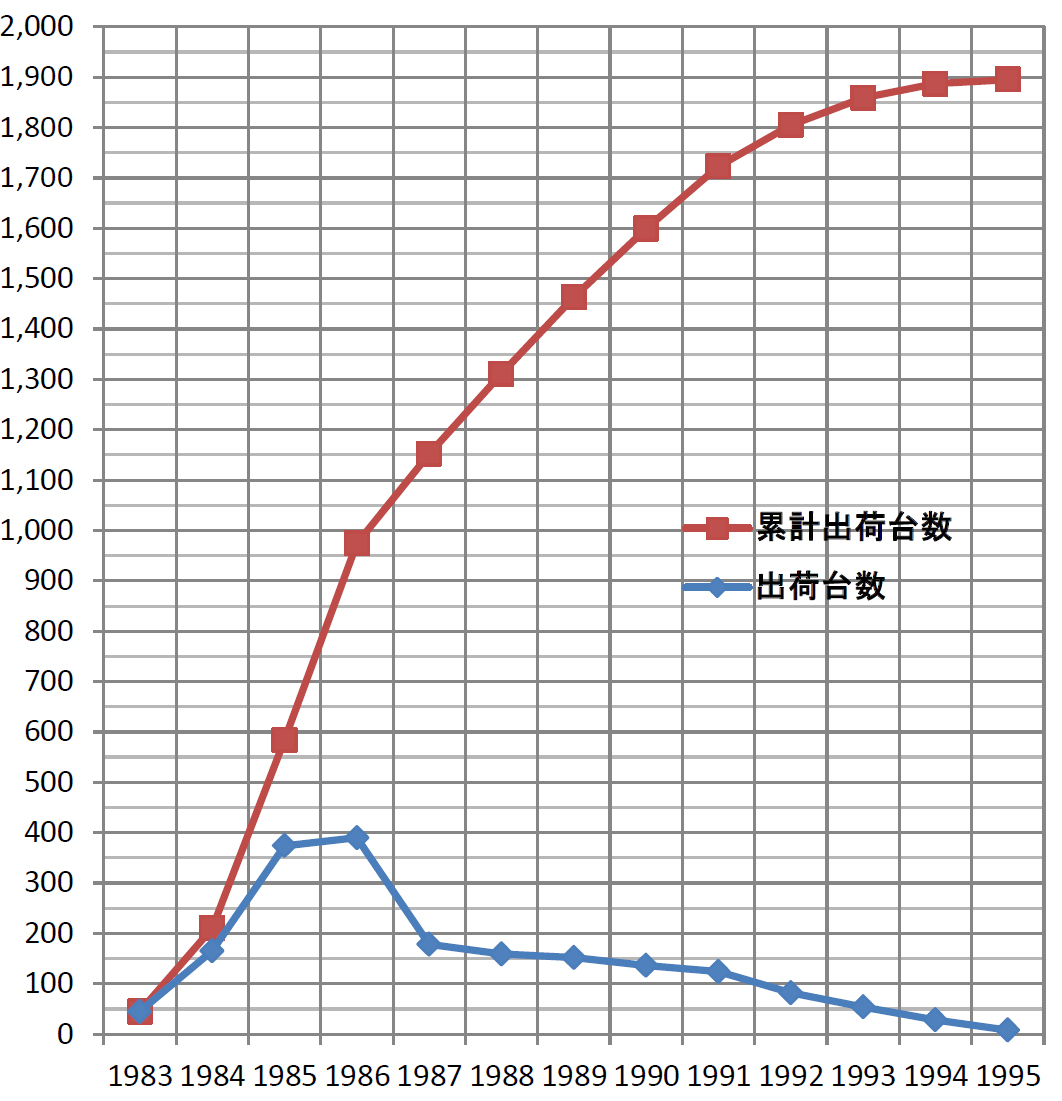
| 年度 | 1983 | 1984 | 1985 | 1986 | 1987 | 1988 | 1989 | 1990 | 1991 | 1992 | 1993 | 1994 | 1995 |
| 出荷台数 | 45 | 165 | 374 | 390 | 178 | 159 | 152 | 136 | 124 | 82 | 54 | 28 | 8 |
| 年度 | 1996 | 1997 | 1998 | 1999 | 2000 | 2001 | 2002 | 2003 | 2004 | 2005 | 2006 | 2007 | 累計出 荷台数 |
| 出荷台数 | 7 | 3 | 5 | 5 | 5 | 6 | 6 | 3 | 0.1 | 0.1 | 0.1 | 0.1 | 1,935 |
[注]1992年度まで1-12月で発表。1993年度より翌年3月、よって累計を合わせるため、任天堂系の1993年度は1月から翌月3月までの15カ月分となっている。
[出典]『情報メディア白書2003』p.72および任天堂Webページ
http://www.nintendo.co.jp/ir/library/historical_data/index.html
パソコンとワープロの日本国内出荷台数の推移1980-1987
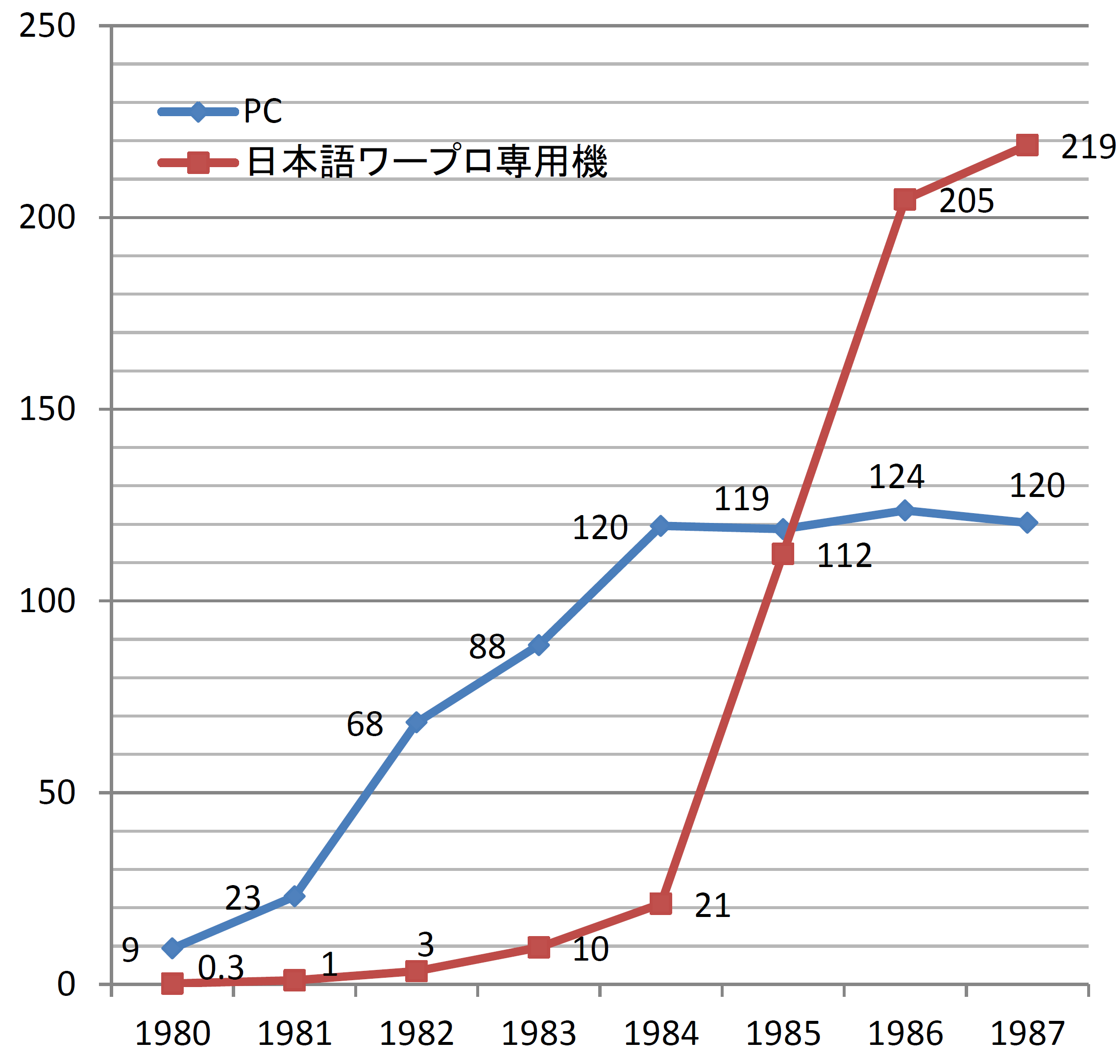
| パソコン出荷台数 | ワープロ出荷台数 | |||
| 年度合計 | 累 計 | 合計 | 累 計 | |
| 1980 | 93,774 | 139,264 | 2,500 | 3,500 |
| 1981 | 229,334 | 368,598 | 11,000 | 14,500 |
| 1982 | 683,051 | 1,051,649 | 34,774 | 49,274 |
| 1983 | 884,967 | 1,936,616 | 96,359 | 145,633 |
| 1984 | 1,195,749 | 3,132,365 | 210,620 | 356,253 |
| 1985 | 1,187,245 | 4,319,610 | 1,122,753 | 1,479,006 |
| 1986 | 1,235,939 | 5,555,549 | 2,047,070 | 3,526,076 |
| 1987 | 1,203,634 | 6,759,183 | 2,188,064 | 5,714,140 |
パソコンの出荷数値は年度ベースで,ワープロの出荷数値は暦年ベース。ともに単位は台である。
引用元は、『情報化白書1989』p.102
原資料は、(社)日本電子工業振興協会「パーソナルコンビュータに関する調査報告書」、通商産業省「機械統計年報」、(杜)日本事務機械工業会「事務機械のピジョン」、「昭和64年事務機械の需要予測」
日本のPC市場シェアの歴史的推移1988-1996
日本のPC市場シェアの歴史的推移1988-1996
| 1988 | 1991 | 1992 | 1993 | 1994 | 1995 | 1996 | |
| NEC | 51 | 52 | 52 | 49 | 43 | 40 | 33 |
| 富士通 | 14 | 8 | 8 | 7 | 9 | 18 | 22 |
| 東芝 | 10 | 9 | 6 | 6 | 4 | 4 | 6 |
| Epson | 10 | 9 | 7 | 6 | 5 | 3 | n.a. |
| IBM | 7 | 7 | 8 | 7 | 10 | 10 | 11 |
| Apple | n.a. | 6 | 9 | 13 | 15 | 14 | 10 |
| Compaq | n.a. | n.a. | n.a. | 2 | 4 | 3 | 3 |
| その他 | 8 | 9 | 10 | 12 | 10 | 10 | 10 |
[出典]Dedrick, Jason; Kraemer, Kenneth L.(1998) Asia’s Computer Challenge: Threat or Opportunity for the United States & the World?, Oxford University Press,p.83
MOS TechnologyのCPU6502の価格-最初は$25、1981年には$4
6502の初期の価格 $200
Santo, B.(2009) “25 Microchips That Shook the World” IEEE Spectrum, May 2009,p.35
6502はその競合CPUより高速に動作しただけでなく、より安価であった。インテルの8080やモトローラの6800が共に200ドル近くで売られていたのに対して、6502は25ドルで売られていたのである。
“The 6502 wasn’t just faster than its competitors—it was also way cheaper, selling for US $25 while Intel’s 8080 and Motorola’s 6800 were both fetching nearly $200.”
“The 6502 wasn’t just faster than its competitors—it was also way cheaper, selling for US $25 while Intel’s 8080 and Motorola’s 6800 were both fetching nearly $200.”
Ekman, S. (2008) “The 6502 Architecture” Case study TDTS10, Computer Architecture, Linköpings Tekniska Högskola
6502が販売開始された当時のIntelの8080およびMotorolaの6800の販売価格は$179であった。こうした競合CPU製品に対して6502の販売価格は約1/7の$25であった。
IntelおよびMotorolaは対抗のために価格を$79に下げた。
IntelおよびMotorolaは対抗のために価格を$79に下げた。
1981年における6502の価格 $4
Jef Raskin, “Preliminary Cost Investigation” (27 September 1979)– in “The Macintosh Project: Selected Papers from Jef Raskin (First Macintosh Designer), Circa 1979,” document 5, version 1.
Location: M1007, Apple Computer Inc. Papers, Series 3, Box 10, Folder 1.
Location: M1007, Apple Computer Inc. Papers, Series 3, Box 10, Folder 1.
Raskinのメモによると、1981年に6502は$4、6809は$12、68000は$90である。なおキーボードの価格$20、64KBのRAMの価格$80に比べて、6502の価格は相対的に極めて低価格であった。
Raskinによる1981年当時における製造コストの見積もり
| 部品 | コスト |
| キーボード | 20 |
| CPU 6502 | 4 |
| 6809 | 12 |
| 68000 | 90 |
| 64KBのRAM | 80 |
| ビデオ・チップ | 15 |
| モデム・チップ | 20 |
| ケース | 15 |
| 電源 | 15 |
| マザーボード(pc board) | 12 |
| その他 | 25 |
| 小計 | 214 |
| 組立費、テスト費用(build, test) | 10 |
| ディスク・ドライブ | 80 |
| ディスプレイ | 40 |
| プリンター | 50 |
| 総計 | 346 |
,/div>
HDDの世界出荷シェア
2009年および2010年の世界出荷台数シェア
| 企業名 | 2009シェア | 2010シェア | ウェスタン・デジタル(WD) | 29.7% | 31.3% | 48.8% |
| 日立グローバル・ストレージ・テクノロジー(HGST) | 16.3% | 17.5% | |
| シーゲート・テクノロジー | 31.5% | 30.0% | |
| 東芝 | 13.3% | 10.9% | |
| サムスン電子 | 9.2% | 10.3% | |
[出典]『日本経済新聞』2011年3月8日朝刊
[原出典]テクノ・システム・リサーチ
2010年の企業向けHDD世界出荷台数シェア
| 企業名 | 2010シェア |
| シーゲート・テクノロジー | 63% |
| 日立グローバル・ストレージ・テクノロジー(HGST) | 24% |
| 東芝 | 11% |
| ウェスタン・デジタル(WD) | 2% |
[出典]『日経産業新聞』2011年3月9日
[原出典]テクノ・システム・リサーチ
1970年代後半期におけるマイクロプロセッサー利用状況 — ホームブリュー・コンピューター・クラブの会員が利用していたコンピュータのCPUの種別
1970年代後半期におけるマイクロプロセッサー利用状況 — ホームブリュー・コンピューター・クラブの会員が利用していたコンピュータのCPUの種別
- 下記の表に示したように1975年および1976年にホームブリュー・コンピューター・クラブの会員を対象としたアンケート調査では、8008,8080,Z80というインテル系8bitCPUの利用数が30(79%),44(63%),63(62%)というように過半数を超えていることがわかる。一方、6800,650xというモトローラ系8bitCPUの利用者数は、4(11%)、16(23%),30(30%)というように着実に割合を増やしているが、少数派となっている。
また1976年1月7日と1976年6月9日の調査結果を比較すると、1月7日に制作中と答えた28のほとんどがインテル系8bitCPUを選択したのではないかと推測される。
| 1975/ 10/15 |
1976/ 1/7 |
1976/ 6/9 |
|
| Intel 4004 | 1 | 1 | |
| Intel 8008 | 5 | 7 | 8 |
| Intel 8080 | 25 | 37 | 53 |
| Motorola 6800 | 2 | 9 | 12 |
| MOS Technology 650x | 2 | 7 | 18 |
| Zilog Z-80 | 2 | ||
| DEC PDP-8 | 4 | ||
| DEC PDP-11/20 | 1 | ||
| DEC LSI-11 | 3 | ||
| その他 | 4 | 9 | 1 |
| 合計 | 38 | 71 | 103 |
| 製作中 | 28 |
[出典]Warren, J.(1977) “Personal and Hobby Computing: an Overview,” Computer, Volume: 10 , Issue: 3, p.14
<表のデータに関する注>1976/6/9の合計値は上記論文では101となっているが、各CPU別の値を合計した数値である103に訂正した。またホームブリュー・コンピューター・クラブでは、インテル系CPUが全体の過半数を超える割合を占めているが、Mos Technologyの事務所からさほど遠くはない場所にあったNew Jerseyの Amateur Computer Group ではMOS Technology 6502が支配的(dominant)であった(同上論文,p.14) 。
任天堂ファミコン関係資料
Downey,J., Kauppila, L., Myhre, B.(2004) “The Design and Implementation of the Nintendo Entertainment System” December 9, 2004
http://web.mit.edu/6.111/www/f2004/projects/dkm_report.pdf
Jonathan Downey
Lauri Kauppila
Brian Myhre
6.111
Introductory Digital Systems Laboratory
Professor Chris Terman
Lauri Kauppila
Brian Myhre
6.111
Introductory Digital Systems Laboratory
Professor Chris Terman
Patrick Diskin (2004) Nintendo Entertainment System Documentation, Ver1.0, August 2004
http://nesdev.parodius.com/NESDoc.pdf
Fayzullin, M. (2005) Nintendo Entertainment System Architecture, version 2.6 (01/24/2005)
https://fms.komkon.org/EMUL8/NES.html
Marat Fayzullin
翻訳:BERO [bero@geocities.co.jp]
“Emulator History in Japan”
翻訳:BERO [bero@geocities.co.jp]
“Emulator History in Japan”
Fayzullin, M.(1996) “Nintendo Entertainment System Architecture” version 1.4 [09/09/1996]
http://nesdev.com/NES_J.TXT
BERO [bero@geocities.co.jp]氏による翻訳
清水洋,鴫原盛之,山口翔太郎(2018)「佐藤秀樹 第2回インタビュー後半:家庭用ゲーム機における任天堂との競争」一橋大学イノベーション研究センター、WP#18-19
http://pubs.iir.hit-u.ac.jp/admin/ja/pdfs/show/2154
競合会社のセガから見た任天堂・ファミコンについての証言あり
上村雅之氏関連
上村雅之, 細井 浩一, 中村彰憲(2013)『ファミコンとその時代』NTT出版
目次
序章 原点としてのファミコン
第1部 テレビゲームの誕生
序章 原点としてのファミコン
第1部 テレビゲームの誕生
第1章 ビデオゲームの誕生
第2章 ファミコンへの道程
第3章 ファミコンの開発とその設計思想
第2章 ファミコンへの道程
第3章 ファミコンの開発とその設計思想
第2部 ファミコンの展開
第4章 ファミコンとゲーム産業の確立
第5章 ファミコンの社会的影響と受容
第5章 ファミコンの社会的影響と受容
結びにかえて――遊びの力
付録 ファミコン関連資料
対談:上村雅之×細井浩一「ファミコンとは何であったのか」
上村雅之(2013)「上村雅之さん 大いに語る。 ファミリーコンピュータ インタビュー(前編)(2013年10月号より)」Nintendo Dream Web
https://www.ndw.jp/post-672/
上村雅之(2013)「上村雅之さん 大いに語る。 ファミリーコンピュータ インタビュー(後編)(2013年10月号より)」Nintendo Dream Web
https://www.ndw.jp/post-714/
ファミリーコンピュータ発売開始30周年のときにニンテンドードリームで行われたインタビューの再掲載記事。「ファミコンの生みの親である上村雅之さんが語る、当時の開発秘話。聞き手はこちらも一世風靡したゲーム雑誌「ファミマガ」こと、ファミリーコンピュータマガジン初代編集長である山森尚さん。」との解説あり。
「「スーファミ」上村雅之氏×「プレステ」久夛良木健氏──“ゲーム機戦争”両雄の歴史的証言から識る90年代プラットフォームビジネスの真髄【セミナーレポート】」電ファミニコゲーマー、2017年12月5日
https://news.denfaminicogamer.jp/kikakuthetower/171205
「社長が訊くスーパーマリオ25周年 ファミコンとマリオ編」
https://www.nintendo.co.jp/n10/interview/mario25th/vol2/index.html
ディスクシステムの生みの親 上村雅之氏インタビュー
https://www.nintendo.co.jp/nom/0408/interv/index.html
「スーパーファミコンを開発「自分の能力知り、一生懸命が肝心」と」千葉工業大学 活躍する校友 NEWS CIT 2005年2月号より抜粋
https://www.it-chiba.ac.jp/cit_news/media/koyu/alumnus/20050215.html
https://www.cesa.or.jp/efforts/keifu/uemura.html
「ファミコンの開発者が語る日本の家庭用ゲーム産業の幕開け 第1回シャープで始まった技術者人生、任天堂との出会い」
https://www.cesa.or.jp/efforts/keifu/uemura/uemura01.html
「ファミコンの開発者が語る日本の家庭用ゲーム産業の幕開け 第2回 任天堂での開発三昧の日々、そしてファミコンの誕生」
https://www.cesa.or.jp/efforts/keifu/uemura/uemura02.html
「ファミコンの開発者が語る日本の家庭用ゲーム産業の幕開け 第3回 ファミコン苦難の船出からブーム爆発、スーパーファミコンへ」
https://www.cesa.or.jp/efforts/keifu/uemura/uemura03.html
「ファミコンの開発者が語る日本の家庭用ゲーム産業の幕開け 第4回 ゲームを後世へ伝えるには…大学での研究教育とアーカイブ構想」
https://www.cesa.or.jp/efforts/keifu/uemura/uemura04.html
https://www.cesa.or.jp/efforts/keifu/uemura/uemura01.html
「ファミコンの開発者が語る日本の家庭用ゲーム産業の幕開け 第2回 任天堂での開発三昧の日々、そしてファミコンの誕生」
https://www.cesa.or.jp/efforts/keifu/uemura/uemura02.html
「ファミコンの開発者が語る日本の家庭用ゲーム産業の幕開け 第3回 ファミコン苦難の船出からブーム爆発、スーパーファミコンへ」
https://www.cesa.or.jp/efforts/keifu/uemura/uemura03.html
「ファミコンの開発者が語る日本の家庭用ゲーム産業の幕開け 第4回 ゲームを後世へ伝えるには…大学での研究教育とアーカイブ構想」
https://www.cesa.or.jp/efforts/keifu/uemura/uemura04.html
CPUのMIPS値の歴史的推移に関するグラフ
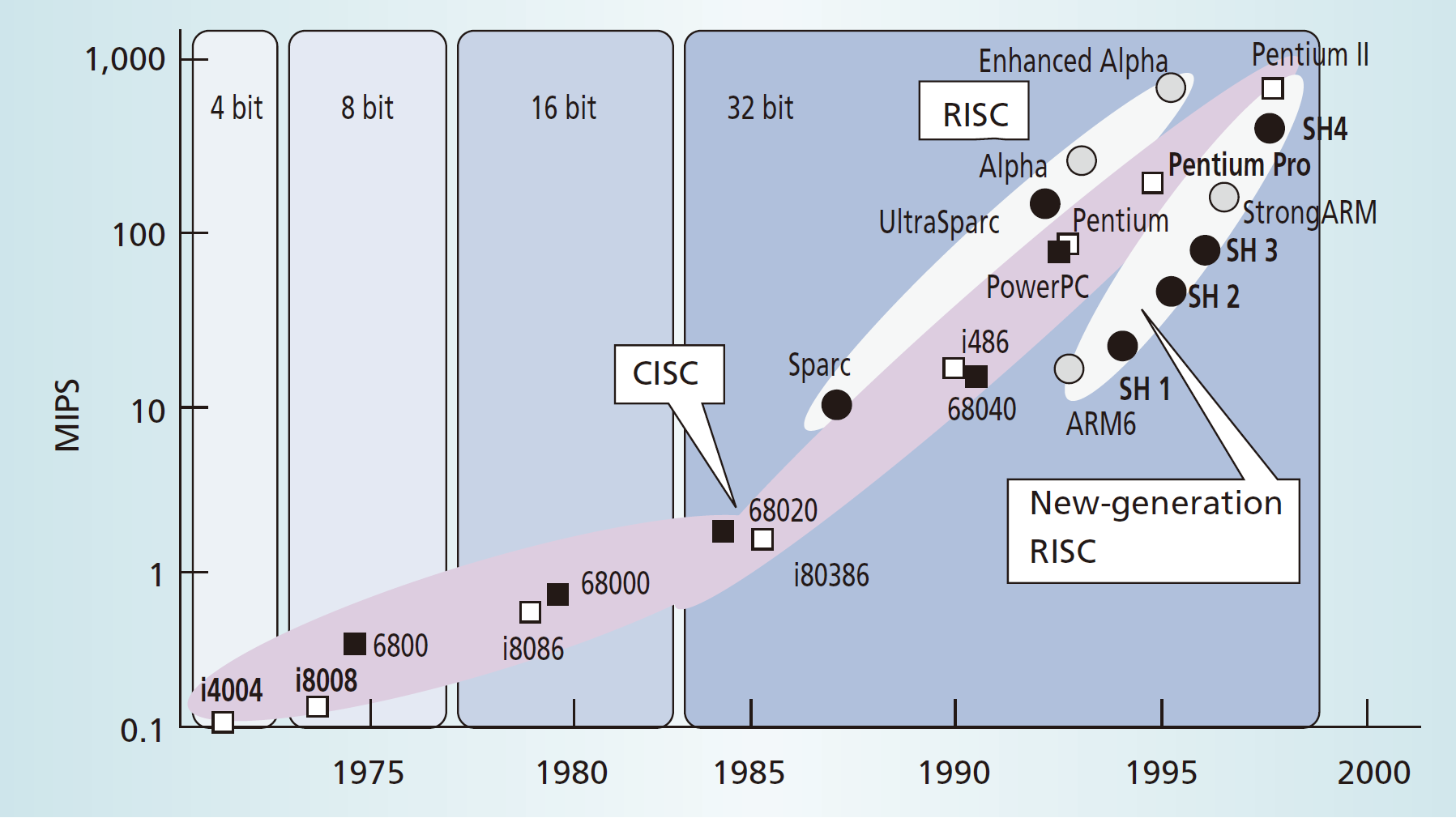
[出典]Makimoto,T., Eguchi,K., Yoneyama, M. (2001) “The Cooler the Better: New Directions in the Nomadic Age,” Computer, April 2001,p.40
Intel 4004(1971)からPentium II(1997)に至るCISCプロセッサーのMIPS値の歴史的向上とRISCプロセッサーのMIPS値の歴史的向上の比較
RISCプロセッサーの系列には、1980年代前半のSparcに始まるRISCプロセッサーと、単位消費電力当たりのCPU性能を重視した新世代のRISCプロセッサーとの2つがある。
半導体技術関連資料
PC産業関連資料
PC産業関連(MIT修士論文)
Farner, Gary Noble (1982) A competitive Analysis of the personal computer industry, S.M. thesis (Cambridge, Mass.: MIT Alfred P. Sloan School of Management), May 1982.
http://dspace.mit.edu/bitstream/handle/1721.1/49568/10338177.pdf
Schreiber, Deborah F. (1983) The strategic evolution of the personal computer industry, S.M. thesis (Cambridge, Mass.: MIT Alfred P. Sloan School of Management), May 1983.
http://dspace.mit.edu/bitstream/handle/1721.1/49888/11215844.pdf
Cohen, Jeremy Michael(1988) Rapid change in the personal computer market : a quality-adjusted Hedonic Price Index 1976-1987,S.M. thesis (Cambridge, Mass.: MIT Alfred P. Sloan School of Management), May 1988.
http://dspace.mit.edu/bitstream/handle/1721.1/37699/19034803.pdf
Kai,Hidetaka(1992) Competitive Strategy Under Standardization in the Personal Computer Industry and Its Influence on New Entrants, unpublished S.M. thesis (Cambridge, Mass.: MIT Alfred P. Sloan School of Management), May 1992.
http://dspace.mit.edu/bitstream/handle/1721.1/12794/27229594.pdf
PC産業関連(論文)
Toong, Hoo-min D., Gupta, Amar (1982) “Personal computers”,Scientific American, Dec. 1982, vol. 247, no.6: p. 86-107.
http://dspace.mit.edu/bitstream/handle/1721.1/48857/personalcomputer00toon.pdf
Einstein,Marcus E. AND Janes C. Franklin “Computer manufacturing enters a new era of growth,” Monthly Labor Review, September 1986
http://www.bls.gov/opub/mlr/1986/09/art2full.pdf
同論文のp.10のTable 1 “Domestic consumption of micro, mini, and mainframe computers,’ 1960-84″が役立つ
Bresnahan, Timothy F.; Stern, Scott; Trajtenberg, Manuel(1996) “Market segmentation and the sources of rents from innovation : personal computers in the late 1980’s” Working paper (Sloan School of Management) ; 3927., WP (International Center for Research on the Management of Technology) ; 154-96.Cambridge, MA : International Center for Research on the Management of Technology, Sloan School of Management, Massachusetts Institute of Technology,64pp.
http://dspace.mit.edu/bitstream/handle/1721.1/48511/marketsegmentati00bres.pdf
PC産業関連(単行本)
Augarten, Stan (1984) Bit by Bit: An Illustrated History of Computers , Ticknor & Fields.
Duetsch, Larry L.(2002) Industry studies, M E Sharpe Inc.,pp.322-323
Freiberger,Paul and Michael Swaine (1984) Fire in the Valley: The Making of the Personal Computer, Osborne/McGraw-Hill.
Loebbecke,James K. and Miklos Vasarhely (1986) Microcomputers , Irwin.
PC産業関連(論文)
34. T. Modis and A. Debecker, “Innovation in the Computer Industry,” Technological Forecasting and Social Change, Vol.33 (1988), pp.267-278.
Apple関連(単行本)
Owen W. Linzmayer (1998) Apple Confidential : The Real Story of Apple Computer, Inc.,p.99
PCの1977-1980の分野別の出荷台数、平均販売価格、市場規模の歴史的推移
PCの1977-1980の分野別出荷台数、平均販売価格、市場規模の推移
Historic Personal Computer Market
| 1977 | 1978 | 1979 | 1980 | 累計 | |
| Business | |||||
| Number of Units(1,000) | 17 | 27 | 60 | 200 | 304 |
| Average Selling Price($1,000) | 1.9 | 2.4 | 1.7 | 1.9 | 1.9 |
| End User Value ($1,000) | 32 | 64 | 103 | 375 | 574 |
| Technical | |||||
| Number of Units | 4 | 13 | 30 | 45 | 92 |
| Average Selling Price |
4 | 3.8 | 3.3 | 2.7 | 3.1 |
| End User Value | 16 | 49 | 100 | 120 | 285 |
| Education | |||||
| Number of Units | 2 | 15 | 30 | 55 | 102 |
| Average Selling Price | 1.5 | 1 | uo | 1.1 | 1.1 |
| End User Value Hobby | 3 | 16 | 30 | 60 | 109 |
| Hobby | |||||
| Number of Units | 30 | 100 | 130 | 148 | 408 |
| Average Selling Price | 1 | 1 | 1.1 | 0.9 | 1 |
| Ead User Value | 30 | 100 | 140 | 137 | 407 |
| Home Application | |||||
| Number of Units | 4 | 20 | 34 | 52 | 110 |
| Average Selling Price |
1 | 0.8 | 0.6 | 0.7 | 0.7 |
| End User Value | 4 | 16 | 21 | 38 | 79 |
| Total | |||||
| Number of Units | 57 | 175 | 284 | 500 | 1,016 |
| Average Selling Price | 1.4 | 1.4 | 1.4 | 1.5 | 1.4 |
| End User Value | 85 | 245 | 394 | 730 | 1,454 |
| Discounts | 18 | 45 | 75 | 175 | 313 |
| Factory Revenues | 68 | 200 | 319 | 575 | 1,141 |
| End User Value by Region | |||||
| United States | 72 | 190 | 263 | 405 | 935 |
| Canada | 4 | 15 | 24 | 35 | 78 |
| Western Europe | 8 | 30 | 70 | 190 | 298 |
| Japan | 1 | 7 | 25 | 75 | 108 |
| Rest of World | 0 | 3 | 12 | 25 | 40 |
| 85 | 245 | 394 | 730 | 1,454 |
[引用元]Farner, Gary Noble (1982) A competitive Analysis of the personal computer industry,unpublished S.M. thesis (Cambridge, Mass.: MIT Alfred P. Sloan School of Management), May 1982., p.155のAppendix B
http://dspace.mit.edu/bitstream/handle/1721.1/49568/10338177.pdf
[原出典]Dataquest
上記の表では、引用元の間違いと思われる数値を下記のように修正している。
1977年のBusiness部門のAverage Selling Priceの値4.6は、台数と市場規模の値から考えて1.9の間違いと思われる。
台数(Number of Units)の累計のTotalの値1,041は、各年の台数の累計および各部門の台数の累計の値から考えて1,016の間違いと思われる。
PCの販売台数シェアおよび総販売台数の推移 1976-1982
vPCの販売台数シェアおよび総販売台数の推移 1976-1982
1982年分は見積もり値
| Company | 1976 | 1978 | 1980 | 1982 |
| MITS | 25% | |||
| IMSAI | 17% | |||
| ProcessorTechnology | 8% | |||
| RadioShack | 50% | 26% | 18% | |
| Commodore | 12% | 20% | 16% | |
| Apple | 10% | 19% | 23% | |
| IBM | 14% | |||
| NEC | 7% | |||
| Osborne | 7% | |||
| Other | 50% | 28% | 35% | 15% |
| Total | 100% | 100% | 100% | 100% |
| Total Units | 15,000 | 200,000 | 500,000 | 1,500,000 |
[原出典]
1976年 McGlynn,Daniel (1979) Personal Computing,Wiley Pub., p.29.
1978年 McGlynn,Daniel (1979) Personal Computing,Wiley Pub., p.30.
1980年 Dataquest
1982年 様々な情報源に基づく著者の見積もり
[引用元]
Farner, Gary Noble (1982) A competitive Analysis of the personal computer industry, unpublished S.M. thesis (Cambridge, Mass.: MIT Alfred P. Sloan School of Management), May 1982., p.18のTable 3.1 PC Industry Unit Sales and Concentration
[関連参考データ]米国の主要PCメーカーの1979年および1982年の世界売上高(単位 100万ドル)
IBMの最初のマイクロプロセッサー IBM 801
1975年にIBMは、RISCの設計原理(RISC design principle)に基づくマイクロプロセッサーの開発を目的とした研究プロジェクトを開始した。最初は「RISCの父」と呼ばれるJohn Cockeが研究プロジェクトを指導した。
4K、 1M、4M DRAMの企業別市場シェア
4K、 1M、4M DRAMの企業別市場シェア
| 1975 | 1990 | 1992 | |||
| 4K DRAM | 1M DRAM | 4M DRAM | |||
| Intel | 46% | 東芝 | 22% | Samsung | 13% |
| Texas Instruments | 25% | Samsung | 14% | NEC | 12% |
| Mostek | 14% | NEC | 10% | 日立 | 11% |
| NEC | 4% | 三菱 | 10% | 東芝 | 11% |
| National | 3% | 日立 | 8% | 富士通 | 9% |
[出典] Gruber,H.(1998) “Learning by Doing and Spillovers: Further Evidence for the Semiconductor Industry.” Review of Industrial Organization, Vol.13, no.6
x86アーキテクチャのCPUの市場シェア関連資料
Albrecht, D. (2005) “AMD v. Intel: American Antitrust Law in the 21st Century” Engineering Law
2005年のAMDのIntelに対する訴訟(the 2005 AMD lawsuit against Intel)を取り扱ったもの
p.9 — 「過去数年間、Intelの売上高シェアは90%以上であり、AMDのシェアは約9%に留まっている。また最近8年間の内の7年間はx86マイクロプロセッサーの売上個数シェアはIntelが少なくとも80%を確保している。」
Point 25 in AMD‟s brief explains that “According to published reports, over the past several years it [Intel] has consistently achieved more than a 90% market share as measured by revenue, while AMD‟s share has remained at approximately 9%…Intel has captured at least 80% of x86 microprocessor unit sales in seven of the last eight years.”[注94] Per American Tobacco Co. v. Unites States, 80% market share constitutes monopoly.95 The 90% revenue figure also reveals a strong grip on the market, although the tests set forth in United States v. du Pont Co. and United States v. Aluminum Co. of America do not comment on the appropriateness of measuring market share by revenue versus of units shipped. In either case, it is hard to deny that Intel‟s 80% or more share of the x86 processor market is monopolistic in character. AMD‟s brief did not specify the sources of their market data, but the factual nature of AMD‟s monopoly claim combined with the well-settled tests for monopoly will be easy to confirm or deny after a thorough discovery process.
[注94]
Black, Henry Campbell, M.A., with Nolan, Joseph R., Associate Justice, Massachusetts Supreme Judicial Court, and Nolan-Haley, Jacqueline M., Associate Clinical Professor, Fordham University School of Law. Black‟s Law Dictionary. Abridged Sixth Edition. West Publishing Company, 1991,p.10
IBM5100のCPU – IBM PALM processor (Put All Logic in Microcode)
IBM5100(1975)はIBMのデスクトップコンピュータであり、そのCPUがPALMプロセッサである。PALMプロセッサはIBM5110(1978),IBM5120(1980)でも用いられている。
PALMプロセッサは1チップのCPUではなく、複数のICから構成されているカード型CPU(single-card microprocessor)である。すなわち、13個の正方形のICチップ(バイポーラゲートアレイ)、3個のTTL(Transistor-Transistor-Logic,バイポーラトランジスタ)、1個のround metal canから構成されている回路板(circuit board)である。
Roberson(1976)によれば、PALMプロセッサのマイクロ命令(microinstruction)は16ビット長で、パリティ用に追加の2ビットを持っている。64KBのメモリ空間
IBMはPALMプロセッサをmicroprocessorと呼んでいるが、これはmicrocodeを利用したマイクロプラグラム方式のプロセッサーという意味である。
カラー写真は下記にある。
http://www.classiccmp.org/dunfield/ibm5100/h/card5100.jpg
またPALMプロセッサに関する解説としては下記がある。
http://en.wikipedia.org/wiki/IBM_PALM_processor
IBM5100に関する解説およびPALMプロセッサのモノクロ写真は下記論文にある
Roberson,Dennis A. (1976) “A Microprocessor-Based Portable Computer: The IBM 5100”
Proceedings of the IEEE, VOL. 64, NO. 6, JUNE 1976,pp.994-
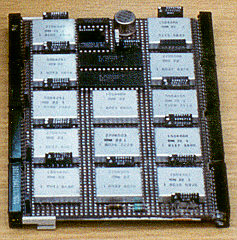
PCの定義をめぐる議論
- “Pop Quiz: What was the first personal computer?”
http://www.blinkenlights.com/pc.shtml
“What was the first computers name?”
http://wiki.answers.com/Q/What_was_the_first_computers_name
IBM社のコンピュータ関連資料 — マニュアル等
IBM360,IBM5100などIBM社のさまざまなコンピュータのマニュアル等の資料を下記からダウンロードできる。
http://bitsavers.org/pdf/ibm/
なおIBMのtypewriter関連資料もダウンロードできる。
http://bitsavers.org/pdf/ibm/typewriter/
マイクロプロセッサー売上高シェア推移 1977,1981,1890,1995
|
米国ドル換算によるマイクロプロセッサー市場の売上高シェア1977,1981,1890,1995
(Market shares in microprocessors percent of sales in US dollars) |
||||
| Firms | 8bit | 16bit | 32bit | 32/64bit |
| (1977) | (1981) | (1990) | (1995) | |
| Intel | 65% | 70% | 60% | 77% |
| Motorola | N/A | 20% | 21% | 5% |
| AMD | – | – | 1% | 7% |
| Cyrix/IBM | – | – | – | 5% |
| Other | – | 10% | 18% | 6% |
| [出典] | Gruber, H. (2000) “The evolution of market structure in semiconductors: the role of product standards,” Research Policy,29, p.735 | |||
| [原出所] | ICE | |||
Market shares of generations in microprocessors and microcontrollers in 1987 and 1996 percent of sales value in US dollars. |
||||
|
米国ドル換算によるマイクロプロセッサーおよびマイクロコントローラー市場の売上高シェア
|
||||
| 1987 | 1996 | |||
| Microprocessors | Microcontrollers | Microprocessors | Microcontrollers | |
| 4-bit | 0 | 28 | 0 | 15 |
| 8-bit | 31 | 67 | 1 | 61 |
| 16-bit | 44 | 5 | 2 | 24 |
| 32-bit | 25 | 97 | ||
| Total | 100 | 100 | 100 | 100 |
| Microprocessors 1996の32bitの中には64-bit microprocessorsにも含まれている。 | ||||
| [出典]Gruber, H. (2000) “The evolution of market structure in semiconductors: the role of product standards,” Research Policy,29, p.737 | ||||
| [原出所]ICE | ||||
Mooreの法則関連資料
Moore,G.E.(1965) “Cramming More Components onto Integrated Circuits,” Electronics, Volume 38, Number 8, April 19, 1965
ftp://download.intel.com/museum/Moores_Law/Articles-press_Releases/
Moore,G.E.(1975) “Progress In Digital Integrated Electronics,”Technical Digest 1975. International Electron Devices Meeting, IEEE, 1975, pp. 11-13.
ftp://download.intel.com/museum/Moores_Law/Articles-press_Releases/Gordon_Moore_1965_Article.pdf
Moore,G.E.(1995) “Lithography and the Future of Moore’s Law,” Proc. SPIE, Vol. 2437, May 1995
ftp://download.intel.com/museum/Moores_Law/Articles-press_Releases/1995_SPIE_Speech.pdf
Intel (2004) “Intel Drives Moore’s Law Forward with 65 Nanometer Process Technology,” Santa Clara, California, August 30, 2004
ftp://download.intel.com/museum/Moores_Law/Articles-press_Releases/Press_Release_Aug2004.pdf
Intel (2005) “Innovation More Important Than Ever In Platform Era,” Intel Developer Forum, San Francisco,March 1, 2005
ftp://download.intel.com/museum/Moores_Law/Articles-press_Releases/Press_Release_Mar2005.pdf
Stanford大学におけるApple関連文書ガイド
Guide to the Apple Computer, Inc. Records, 1977-1998
http://www.oac.cdlib.org/data/13030/n3/tf4t1nb0n3/files/tf4t1nb0n3.pdf
http://www-sul.stanford.edu/depts/spc/xml/m1007.xml
| Repository: | Stanford University. Libraries. Dept. of Special Collections and University Archives. |
| Creator: | Apple Computer, Inc. |
| Title: | Apple Computer, Inc. Records, |
| Dates: | 1977-1998 |
| Extent: | ca. 600 linear ft. |
| Abstract: | Collection contains organizational charts, annual reports, company directories, internal communications, engineering reports, design materials, press releases, manuals, public relations materials, human resource information, videotapes, audiotapes, software, hardware, and corporate memorabilia. Also includes information regarding the Board of Directors and their decisions. |
| Collection number: | Special Collections M1007 |
Guide to the Apple Computer, Inc. Ephemera collection, 1978 – 1998
http://www.oac.cdlib.org/data/13030/32/ft48700332/files/ft48700332.pdf
http://findingaids.stanford.edu/xtf/view?docId=ead/mss/m0825.xml
| Repository: | Stanford University. Libraries. Dept. of Special Collections and University Archives. |
| Creator: | Apple Computer, Inc. |
| Title: | Apple Computer, Inc. ephemera collection, |
| Dates: | 1978 – 1998 |
| Extent: | 9 linear ft. |
| Abstract: | This collection contains annual reports, internal communications, corporate communications, engineering reports, manuals, product information files, catalogs, price lists, Apple publications, human resource information, conference and workshop information, software, hardware, and corporate memorabilia. |
| Collection number: | M0825 |
| Language: | English. |
Computer史関連サイト
通史的WEBページ
- Jeremy Meyers,A Short History of the Computer(B.C.-A.D.1993)
http://www.softlord.com/comp/ - The Computer History Museum, Virtual Visible Storage
Today in computer history
年表
カテゴリー別歴史(Laptop / MS-DOS / Microsoft Windows / Apple’s operating system / Unix, Linux, and variants’ / Internet / Motherboard / Processor / Memory / Hard drive / Data storage / Computer USB / Computer monitor / Printer / Computer networking / Cell phone / Programming language / Game / Computer virus) - Computer Hope, Computer history
Today in computer history
Computer history timeline(BC – Today)
Browse history by category
Related information
コンピュータ関連資料リスト
- ACM (2020) ACM Research Materials
ACM所蔵のコンピュータ資料のリスト
年表
- The IEEE Computer Society timeline
初期コンピュータの画像を含む
- Computer Industry History
the Electronic Software Publishing Corporationによる歴史的ページへのリンク集
- Information Technology Industry TimeLine
https://web.archive.org/web/20090419173757/http://febcm.club.fr/english/information_technology/information_technology_1.htm
PC史関連サイト
- Computer History Museum
http://www.computerhistory.org/ - Computer History Exhibits
http://infolab.stanford.edu/pub/voy/museum.html- Computer History Exhibits Photo Tour
http://infolab.stanford.edu/pub/voy/museum/phototour.html
Logic Device Timeline [CHM, gio] basement – cabinet 1 {1}
Election News text (1952) [CHM] basement – cabinet 1 {1}
Univac Technology (1952) [CHM] basement – cabinet 1 {2}
PDAs and KBMS group [MIS, Kaplan]basement – cabinet 2 {2}
The Apollo computer has been returned to the CHM.
Apollo-2 display [CMHC](1960) basement {8}
XeroxAlto-text [CHM]basement – cabinet 3 {2}
IBM PC [Gio] basement – cabinet 4 {3}
The Original Google Computer [Page and Brin] basement – cabinet 5 {3}
Professor Forsythe, founder and First Chairman of the Stanford CSD floor 1 – cabinet 2 {4}
CSD founding faculty (1965) floor 1 cabinet 3 {2}
IBM-CPC (1960) floor 1 cabinet 3 {3}
SAIL computer Lab display floor 1 – cabinet 4 {9}
SU Computer-Lab Seized by Vietnam protesters (1973) floor 1 – cabinet 5 {2}
LOTS student computing and ACME timesharing signalling box. floor 1 cabinet 5 {2}
Disk Memories display [ME] floor 1 cabinet 1 {8}
Mechanical and Electrical calculators [Forsythe, Floyd, Gio] floor 1 cabinet 2 base {8}
Stanford Programming contest trophies, John McCarthy Turing award
The Mobi-1 Robot and the Stanford Arm [Stanford Robotics Lab, Scheinman] floor 1, cabinets 6 and 7 {8}Printing Technology [Gio] [Warren] (1968) staircase to floor 2 left {}
Communications, early Modems [Gio] [CMHC] (1968) staircase to floor 2 right (was on floor 3) {}
Men of Mathematics Poster [IBM]; in staircase from the first to the second floor. The on-line tour also shows some Women on Mathematics.
Early Devices display: memories [CMCH] floor2 left {9}
IBM 704 Vacuum Tube Assembly [CMHC] (1957) floor2 left {1}
Electric Key Punch [IBM] floor2 left {3}
MIT Whirlwind display [CMCH] floor2 right {5}
Computing without Electricity, with Integrators [Newcomer] (1917) floor 2 side (was floor4 right) {3}
more pictures of the Integrators [Newcomer] (1916) floor2 side {3}
Early Computer History Poster (British), Microprocessor Provenance Poster.; in staircase from the second to the third floor.
IBM 360 display [Gio], [IBM] floor3 left {6}
Disk Technology and Fortran Game [CMHC] floor3 left {2}
Early Modems [Gio] [CMHC] (1968) floor3 right (was left) {}
DEC PDP display [CMHC] floor3 right {9}
Timesharing display [CMHC] under construction, floor3 right {9}
CROMEMCO display [ Andy Berg, Ray Borrill, Roger Melen, Jeff Johnson, Roger Parkinson, Gio Wiederhold] {10}
Languages, Silicon Valley posters. in staircase from the third floor.
Home Computer Display (1970’s) left floor4 left {8}
SUN display [FB] floor4 right {10}
Cray display [CMHC] removed {10}
Apple Display [JU, Gio] being installed {10}
David Gries’ compiler book in card form [Gries] (1973) {3}
Galaxy-Game machine [Pitts] (1971) removed to CHM {3}
To view individual photos, use the detail list (original pictures, now incomplete).
Stanford大学におけるMacintosh関連文書
Making the Macintosh: Technology and Culture in Silicon Valley
http://library.stanford.edu/mac/index.html
Home | Approach | Credits | Feedback
Archive: Primary Documents | Images | Interviews
Subjects: Counterculture | Early Mac | Mouse | Technical Writing | Marketing | User Groups
“Making the Macintosh”は、Macintoshの歴史に関する文書をオンライン化するプロジェクトである。
DRAMの出荷数、単価などの歴史的推移1974-1988
DRAMの出荷数、単価などの歴史的推移1974-1988のデータ
DRAMの出荷数や平均価格の歴史的推移1974-1988に関する資料データがエクセル形式でhttp://phe.rockefeller.edu/LogletLab/DRAM/dram.xlsからダウンロードできる。
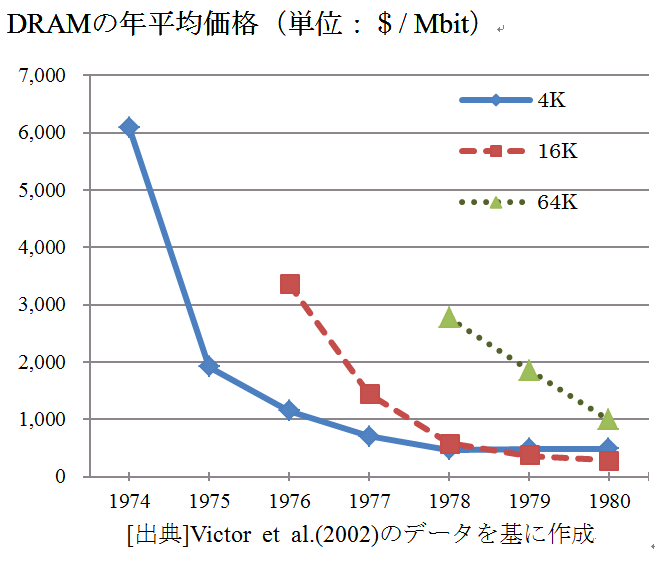
この資料を用いた論文Nadejda M. Victor and Jesse H. Ausubel(2002) “DRAMs as Model Organisms for Study of Technological Evolution,” Technological Forecasting and Social Change, 69(3), pp.243-262もダウンロードできる。
http://phe.rockefeller.edu/LogletLab/DRAM/
Intel 4004関連資料
■学術的記事
Faggin, F., and M. Hoff (1972) “Standard Parts arid Custom Design Merge in Four-Chip Processor Kit,” Electronics, Apr. 24, 1972, pp. 112 116.
本資料では4004のターゲットが、速度が主要なファクターではない製品領域で、コスト及びサイズの最小化を図る新しい応用にあることが記されている(This set of components is not designed to compete with the minicomputer, but rather to extend the concept of the dedicated computer into new applications where the minimization of cost and size are very important, but where speed is not a major factor.)
本資料のpp.18-19でFagginは、「インテルが4004の設計のためにFagginを雇う2,3週間前に、Hal FeeneyがCTCの8ビットマイクロプロセッサの仕事のためにインテルに加わっていた。FeeneyはMazorやCTCと一緒に、[8ビットマイクロプロセッサ]チップのspecificationを完成させ、CTCのアーキテクチャをsiliconにimplementationするために必要な修正を行う仕事に携わった。」ことを挙げて、インテルが8008が最初のマイクロプロセッサになる可能性があった、としている。
しかし実際には、CTCの財政上の問題でCTCのプロジェクトはすぐに「休眠」(dormant)状態となり、Feeneyは別なプロジェクトに回されたため、4004に先を越された、としている。
なお1971年1月に同プロジェクトが再開された時には、4004の開発経験で培われたa proven design methodologyが8008の開発に役立った、とされている。(The designers’ recent experience with the 4004 provided a proven design methodology that paved the way for the 8008. )
Feeneyが8008の詳細設計をおこない、1972年3月に動作するチップができた、とされている。
しかし実際には、CTCの財政上の問題でCTCのプロジェクトはすぐに「休眠」(dormant)状態となり、Feeneyは別なプロジェクトに回されたため、4004に先を越された、としている。
なお1971年1月に同プロジェクトが再開された時には、4004の開発経験で培われたa proven design methodologyが8008の開発に役立った、とされている。(The designers’ recent experience with the 4004 provided a proven design methodology that paved the way for the 8008. )
Feeneyが8008の詳細設計をおこない、1972年3月に動作するチップができた、とされている。
http://ieeexplore.ieee.org/stamp/stamp.jsp?arnumber=4776530
「LSIデバイスの低コスト化のためには、初期コストを無視できるようにするほどの大量生産が必要である。初期コストとしては、設計作業、バグ取り作業、動作テスト作業、新製品に対する学習曲線などが含まれる」(To obtain low cost LSI devices, production must reach sufficient volumes to make the start-up costs insignificant. These start-up costs include design and debugging, generation of test procedures, paperwork for production control, and the manufacturer’s learning curve for a new product.)
Aspray, W.(1997) “The Social Construction of the Microprocessor: A Japanese and American Story” in Andrew Goldstein & William Aspray eds. Facets: New Perspectivies on the History of Semiconductors, (New Brunswick: IEEE Center for the History of Electrical Engineering, 1997), pp.215-267
「Marcian “Ted” Hoffが世界最初のマイクロプロセッサ Intel4004の設計をおこなったと広く信じれている」ことを批判した論文。マイクロプロセッサの開発は、エンジニア(engineers)と技術的アントレプレナー(technological entrepreneurs)がそれぞれ「大きく異なる技術的目標」(with significantly different technical objectives)の下で協力して創造されたものである、すなわち、「大まかな概念的展望」(broad conceptual vision)と「骨が折れる緻密な作業」(painstaking detail work)の結合によって創造されたものである、としている。
本論文の内容要約を紹介している下記WEBページから、本論文のPDFをダウンロードできる。
Engineering and Technology History Wiki(ETHW) “Archives:The Social Construction of the Microprocessor A Japanese and American Story”
https://ethw.org/Archives:The_Social_Construction_of_the_Microprocessor_A_Japanese_and_American_Story
本論文の内容要約を紹介している下記WEBページから、本論文のPDFをダウンロードできる。
Engineering and Technology History Wiki(ETHW) “Archives:The Social Construction of the Microprocessor A Japanese and American Story”
https://ethw.org/Archives:The_Social_Construction_of_the_Microprocessor_A_Japanese_and_American_Story
佐野正博「マイクロプロセッサーIntel 4004の製品開発プロセス」
https://www.sanosemi.com/document/Intel_4004_Ver4-2.pdf
■雑誌記事
Intel 4004 – 35th Anniversary Project
4004の最初期の広告

■WEB
日経XTech「世界初のCPU「4004」開発回顧録」
日経ITproに掲載された「嶋正利のプロセッサ温故知新」の2006年12月から2007年7月にかけての記事を転載したもの