- Jean-Baptiste Schwilguéの加算機(1844年12月24日出願、1845年3月1日特許取得、フランス特許番号623)
- Computer Timeline “Jean-Baptiste Schwilgue”
- Denis Roegel (2008), “An Early (1844) Key-Driven Adding Machine,” IEEE Annals of the History of Computing, Vol. 30, No. 1, pp. 59–65.
- Roegel,Denis (2016) “Before Torchi and Schwilgué, There Was White” IEEE Annals of the History of Computing, Vol.38 Issue 4, pp.92-93.
- Mounier-Kuhn,Pierre (2020) “L’industrie des calculatrices : un leadership français suivi d’une domination germanique et américaine.”
- Victor Schiltの加算機(1850年頃)
- Du Bois D. Parmeleeの計算機(1850年2月5日特許取得, U.S. Patent 7074)
- トーマス・ヒル(Thomas Hill)の加算機(1857年11月24日特許取得, U.S. Patent 18692)
- Thomas Hill (1857) “On a New Form of Arithmetical Complements,” Proceedings of the American Association for the Advancement of Science, Vol.11, p.82
- Turck,J. A. V.(1921) Origin of Modern Calculating Machines, Chicago: The Western Society of Engineers, 1921, pp. 22-29, 61-62.
- Kidwell,P. A. (1998) “Thomas Hill: Minister, Intellectual and Inventor,” Rittenhouse, 12 (October 1998): pp. 111-119.
- Denis Roegel (2008), “An Early (1844) Key-Driven Adding Machine,” IEEE Annals of the History of Computing, Vol. 30, No. 1, pp. 59–65.
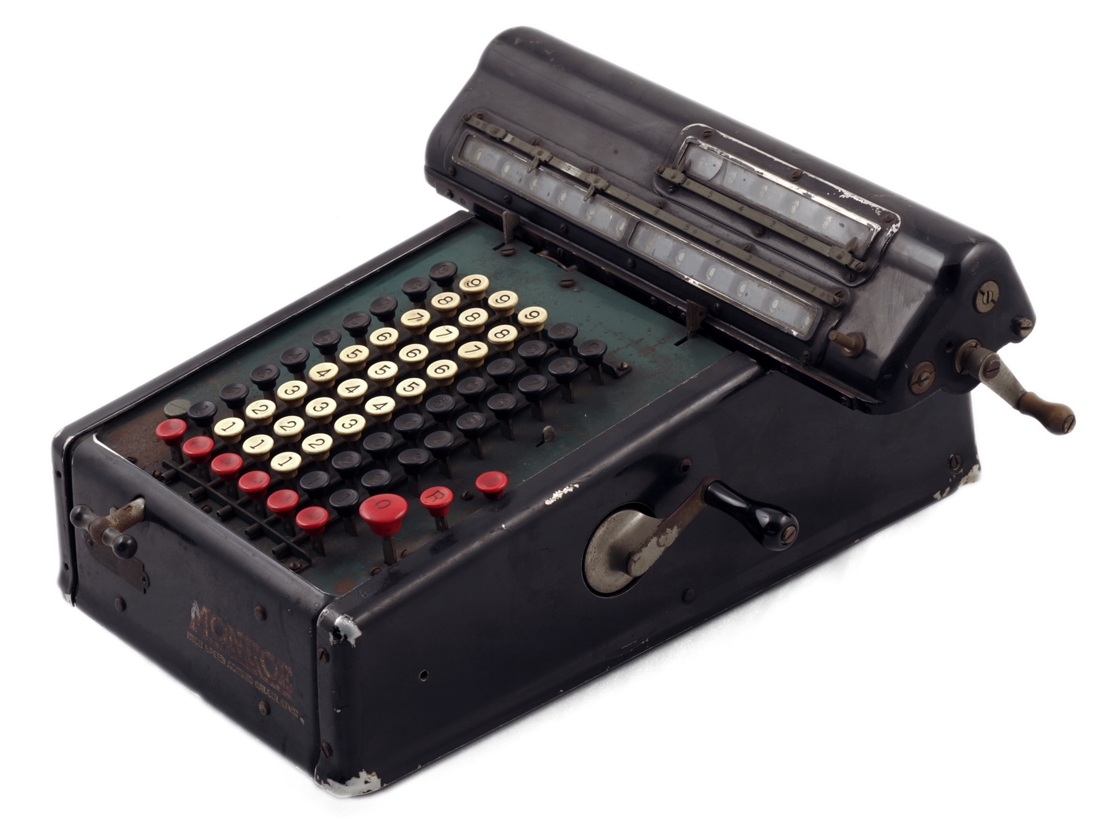
- Monroe K-120(1921)
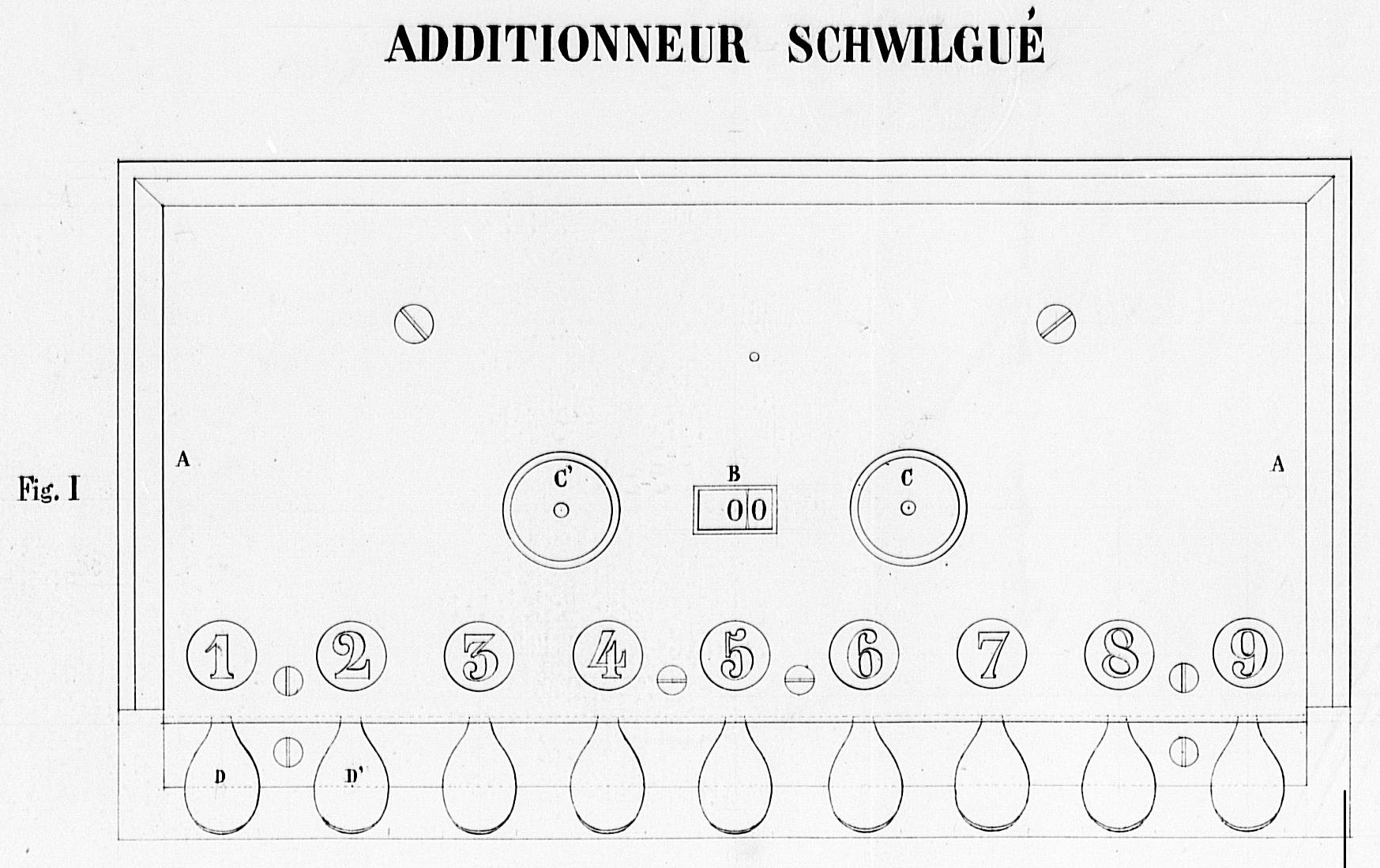
[図の出典] Schwilgue Jean-Baptiste, Schwilgue Charles-Maximilien (1844) “additionneur mécanique”
https://archives.inpi.fr/brevets?detail=445592
http://www.computer-timeline.com/timeline/jean-baptiste-schwilgue/
Schwilguéの加算機の写真がある。
https://muse.jhu.edu/pub/87/article/235251/pdf
https://muse.jhu.edu/article/235251
論文タイトルの「初期のキー駆動式加算機(1848)」[An Early (1844) Key-Driven Adding Machine]は、Schwilguéの加算機のことを指す。p.59にチューリッヒ工科大学所蔵の1851年製のSchwilguéの加算機の写真が3点掲載されている。
Verfasst von Herbert Bruderer (2014) “Zwei der ältesten Rechenmaschinen an der ETH aufgetaucht”
https://ictk.ch/inhalt/zwei-der-%C3%A4ltesten-rechenmaschinen-der-eth-aufgetaucht
2013年末にチューリッヒ工科大学天文台の所蔵品として、Schwilguéの加算機、および、コルマール(Charles Xavier Thomas de Colmar)のアリスモメーターが見つかったことを受けて、書かれた解説記事。
https://ieeexplore.ieee.org/document/7763737
19世紀前半期におけるキー駆動式計算機として、James White (1822)、Luigi Torchi(1834)、Jean-Baptiste Schwilgué(1844)の機械が取り上げられている。
その写真は、下記WEBページで見ることができる。
National Museum of American History “Schilt Adding Machine”
https://americanhistory.si.edu/collections/object/nmah_690194
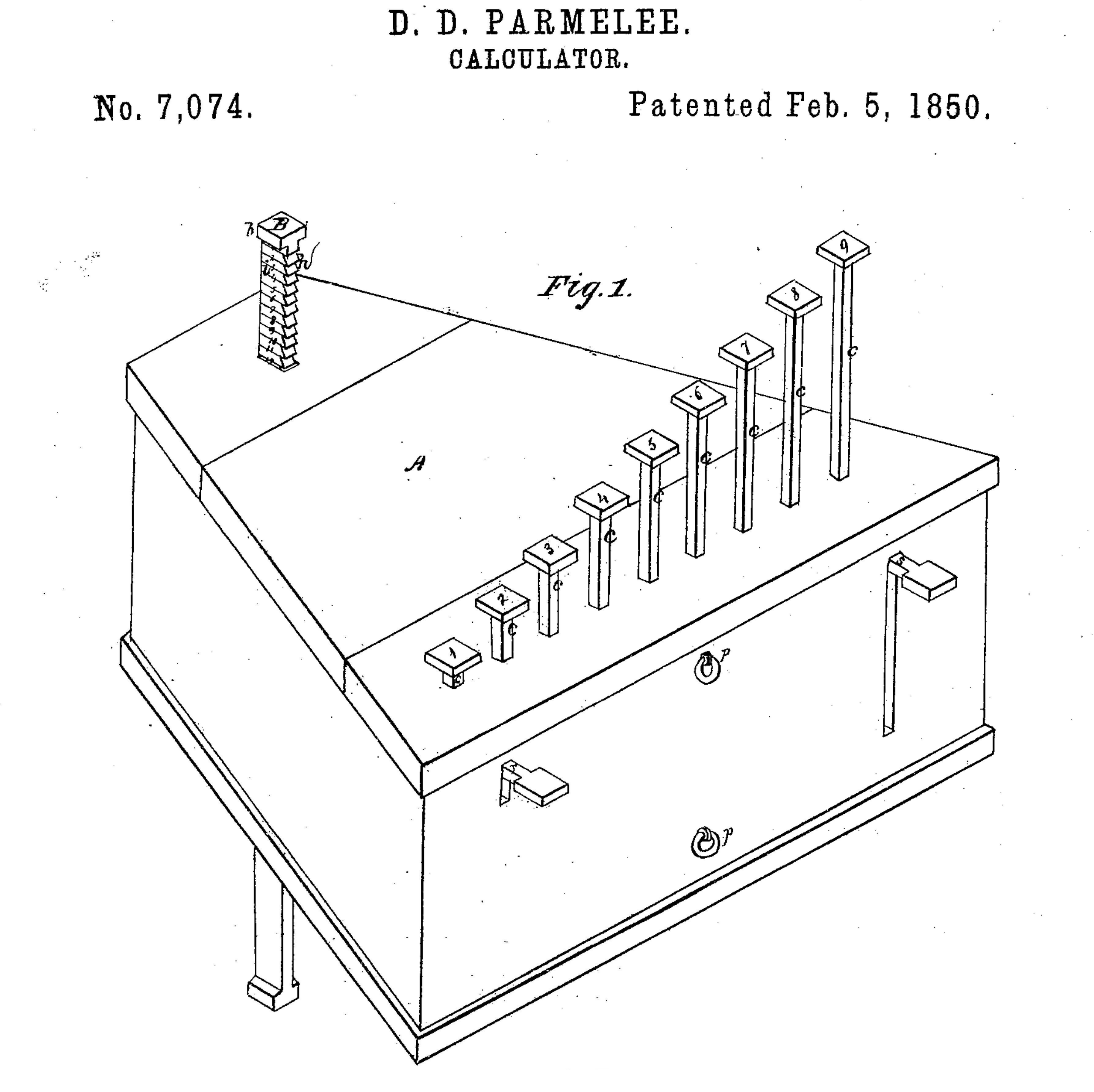
[図の出典]Du Bois D. Parmelee(1950) “Calculating-machine”
https://patents.google.com/patent/US7074A
上記の図は、Parmeleeの1857年の特許出願書類における図1である。図の右側に1~9までの9個のキーがある。この特許出願の図では、右側のキーを押した分だけ、図の左側の棒Bが上に伸びることで加算結果が示されるようになっている。(3のキーを押せば、3つ分だけ棒Bが上に伸び、9のキーを押せば9つ分だけ棒Bが上に伸びる。結果として、3+9の加算結果が、特許出願の図の状態にあるように12となる。)
なおParmeleeは、「表示は必ずしもまっすぐな棒で行う必要はない。一つの円、あるいは、「十の位」を示す円、「百の位」を示す円などを含む一連の円を用いることもできる。また、これらを動かす機構としては、レバーのほかにラック・アンド・ピニオンを利用することも可能である。」(The indications need not necessarily be given on a straight rod, but may be by a circle, or by a series of circles one indicating “tens’ another “hundreds” and so on, and these may be acted on by a rack and pinion as well as by a lever.)と特許出願書類の中で記述している。ただし、その具体的な方法は示されてはいない。
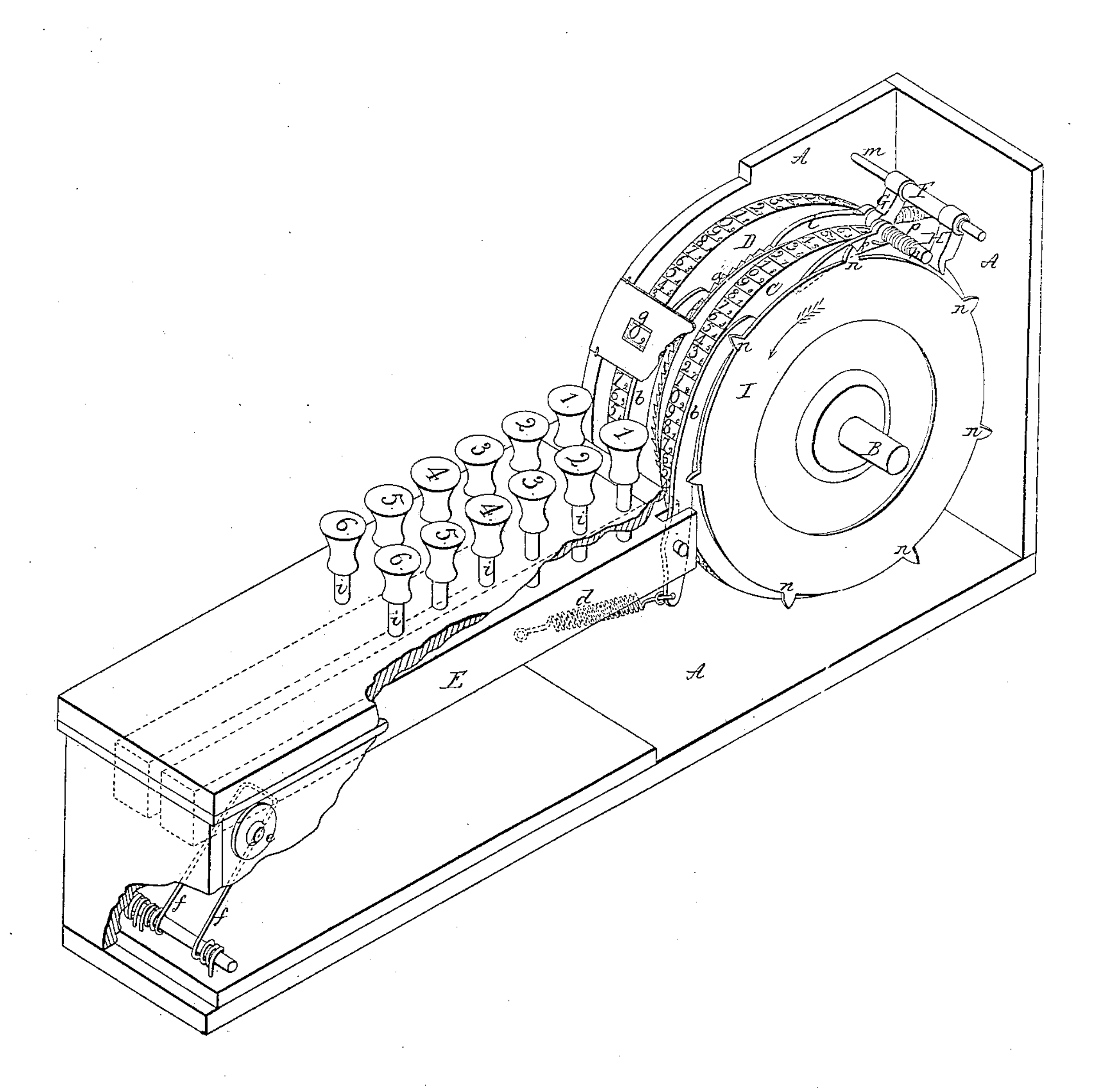
https://patents.google.com/patent/US18692A/
上記の図は、Hillの1857年の特許出願書類における図である。この図、および、特許模型では1から6までの6個のキーしかないが、特許出願書類の図の右側の計数輪(count-wheel)の外周部に0~9の数字が記載されていることに示したように、実際の製品ではキーの数を増やすことが想定されていた。
また出願書類の説明によると、図で手前の計数輪Cが1の位を、計数輪Dが10の位を示すためのものである。また図ではそのように2桁の数字を取り扱う装置であるが、計数輪の数を増加させることでもっと数多くの桁数の計算をすることが想定されていた。
ただしHillの特許は製品化されてはいない。というのも、Turck(1921)によれば、「ヒルの発明品は正しく加算を行うことができない。それゆえヒルの発明品を加算機と呼ぶのは誤りである。」”To call the Hill invention an adding machine is erroneous since it would not add correctly. “(p.29)だからである。
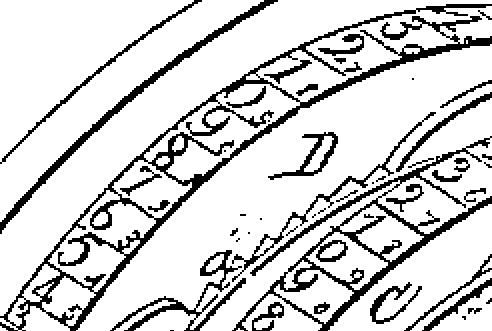
なお、下図のように計数輪の同じ位置に大きさの異なる2つの数字が割り当てられているが、小さい数字は9の補数である。すなわち、「大きい数字は加算および乗算に使用され、小さい数字は減算および除算に使用される。」(The larger characters are to be used for addition and multiplication and the smaller ones for subtraction and division.)という設計になっている。
国立アメリカ歴史博物館の下記Webページに、Hillの1857年の特許模型の写真がある。
National Museum of American History “Hill Arithmometer”
https://www.americanhistory.si.edu/ja/collections/object/nmah_690827
関連資料
These supplements may be used in arithmetical machines by printing the supplement of each digit in a smaller type by its side, so that we add by looking at the larger figures, and subtract by looking at the smaller.
https://www.gutenberg.org/ebooks/69386
https://muse.jhu.edu/pub/87/article/235251/pdf
https://muse.jhu.edu/article/235251

Museo Nazionale Scienza e Tecnologia Leonardo da Vinci所蔵
195cm×37cm、重量15kg